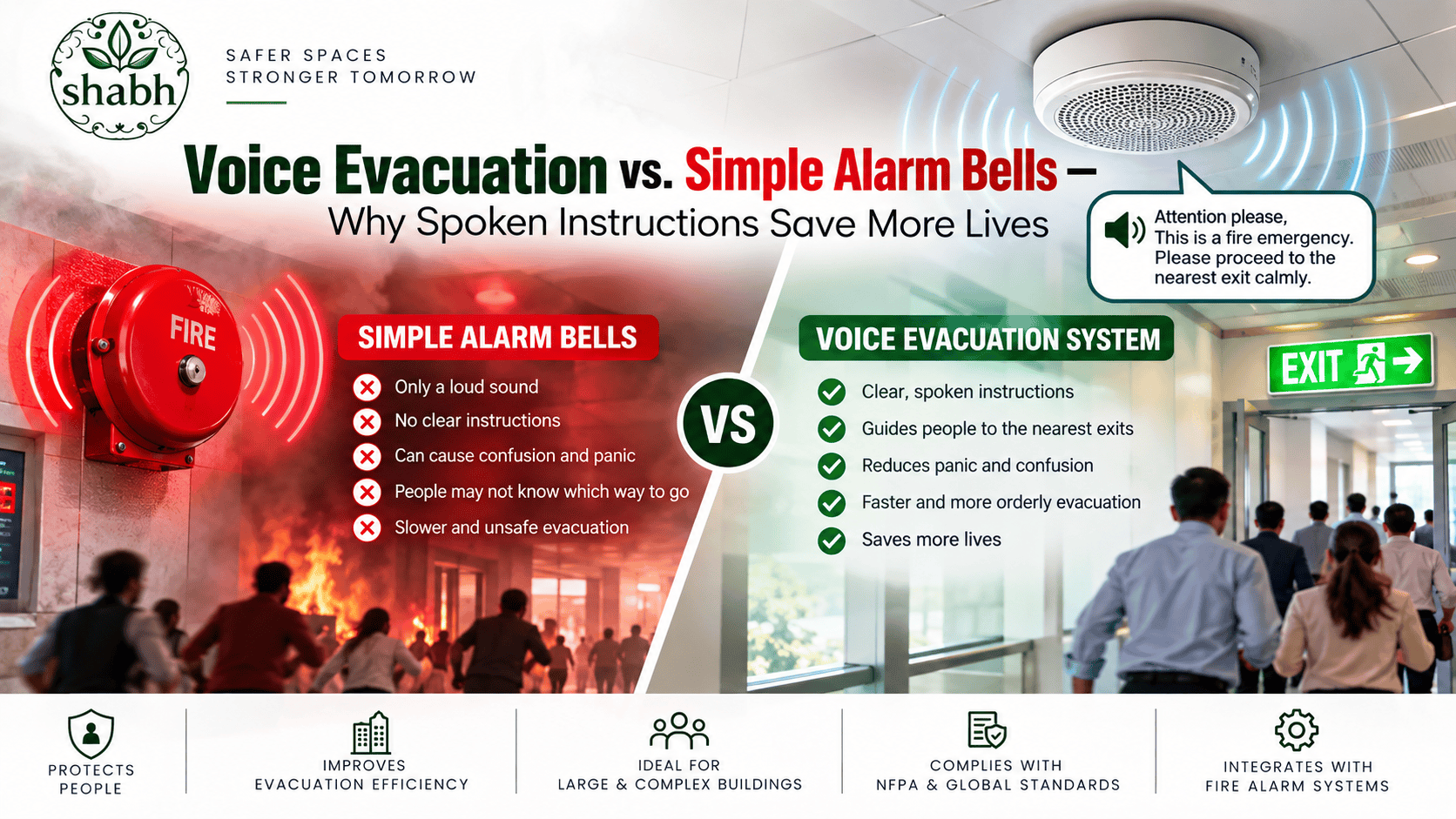
Voice Evacuation vs. Simple Alarm Bells — Why Spoken Instructions Save More Lives
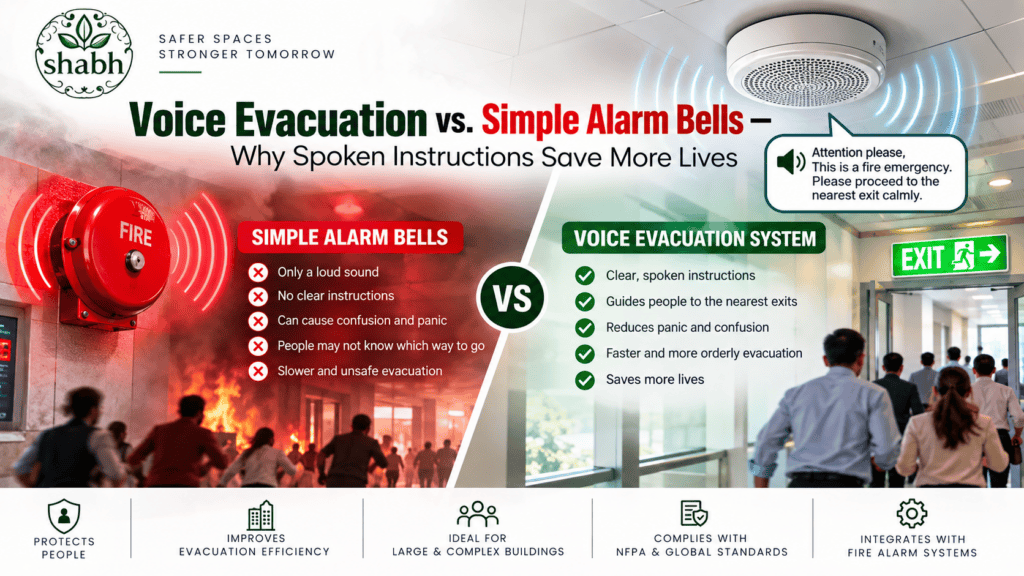
Voice Evacuation System vs. Simple Alarm Bells
A fire alarm bell has done its job the moment it makes noise. Whether that noise actually gets people to leave the building — and leave it the right way — is a separate question entirely, and it’s one most fire alarm systems were never designed to answer.
The Problem With a Bell Over Voice Evacuation System
A conventional fire alarm — a bell, a horn, a siren — communicates exactly one piece of information: something is happening. It doesn’t say what, where, or what to do about it. That gap gets filled by the people hearing it, and human behavior research on real fire evacuations consistently shows the same pattern: people don’t move immediately when an alarm sounds. They look around. They ask a colleague if it’s a drill. They finish what they’re doing. They wait for someone else to act first.
This isn’t irrationality — it’s a reasonable response to an uninformative signal. A bell can mean a real fire, a false alarm from burnt toast, a test, or a drill, and from the listener’s seat there’s no way to tell which. In buildings with frequent false alarms (common in facilities with poorly tuned detection, which we’ve covered before in the context of fire alarm programming), this hesitation gets worse over time — people learn, correctly, that the bell is usually nothing, and that learned response doesn’t turn off the one time it matters.
What a Voice Evacuation System Actually Changes
A voice evacuation system replaces or supplements the bell with intelligible spoken instructions, delivered through the same speaker network, telling occupants specifically what’s happening and what to do: which floor is affected, which stairwell to use, whether to evacuate immediately or stay in place. This does three things a bell cannot:
It removes ambiguity. A spoken instruction doesn’t need interpretation. “A fire has been reported on the third floor. Please evacuate using the north stairwell” leaves no room for “maybe it’s nothing.”
It enables phased evacuation. In a high-rise, evacuating every floor simultaneously creates dangerous stairwell congestion — people from upper floors converge with people from the fire floor at the same pinch points. A voice system lets you instruct the fire floor and floors immediately above/below to evacuate first, while other floors are told to stand by, staging the evacuation instead of triggering a building-wide crowd surge. This is standard practice in high-rise life safety design and effectively impossible to achieve with a single alarm tone.
It can be updated in real time. Fire wardens or the fire department can issue live announcements as the situation develops — redirecting people if a planned exit route becomes blocked, or confirming “all clear” once it’s genuinely safe, rather than leaving people to self-determine when the danger has passed.
Where This Matters Most
Not every building needs a full voice evacuation system — the cost and complexity are real, and a well-designed conventional alarm is adequate for many occupancy types. But a few categories benefit disproportionately:
- Hospitals, where immediate full evacuation is often the wrong answer — patients may need to be moved to an adjacent fire-protected zone (horizontal evacuation) rather than down stairwells, and only a spoken instruction can communicate that distinction to staff and ambulatory patients in real time.
- High-rise buildings, where phased evacuation isn’t a nice-to-have, it’s often the only way to prevent stairwell overload during an actual event.
- Large assembly and retail spaces (malls, shopping complexes — relevant given the audit activity we’ve covered in Gurugram), where occupants are unfamiliar with the building layout and need explicit directional instruction, not just a signal to move.
- Manufacturing plants and factories with high ambient noise, where a simple bell may not even be distinguishable from normal operational sound, but a voice announcement through a properly designed sound system can cut through.
Where This Fails in Practice
Voice evacuation systems fail in the same quiet, undetected way most passive life safety systems do — not because the hardware is absent, but because it was never verified to actually work as intended:
Intelligibility was never tested after installation.
A speaker system can be wired correctly and still be unintelligible in practice — reverberant spaces (atriums, parking structures, large warehouses) can turn clear speech into indistinct noise. Proper commissioning includes a Speech Transmission Index (STI) measurement, not just a “can you hear something” walk-through.
Pre-recorded messages are generic or outdated.
A message that doesn’t specify a zone, floor, or action defeats the purpose — it becomes a more expensive bell. Messages need to be tied to the actual zoning of the building and updated when the building’s layout or floor plan changes.
Live microphone paging was never rehearsed.
The ability for a fire warden or security desk to override pre-recorded messages with live instructions is only useful if the person operating it knows how, under pressure, during an actual event — which requires drilling, not just installing the hardware.
Battery backup and amplifier capacity weren’t sized for the full building.
A voice system needs to be audible and intelligible across every zone simultaneously during a real event, which draws significantly more power than an occasional test. Undersized backup power is a common, invisible gap.
The Honest Trade-off
Voice evacuation systems cost more to install, commission, and maintain than a conventional bell system, and they require integration with the fire alarm control panel, zoning design, and often a dedicated public address amplifier rack. For a single-storey warehouse or a small commercial unit, a well-maintained conventional alarm with clear signage may be entirely adequate, and the added cost of voice evacuation wouldn’t proportionately improve outcomes. The decision should be driven by occupancy type, building height, and evacuation complexity — not treated as a blanket upgrade every facility needs.
FAQ
Q: Is voice evacuation required by code in India, or is it optional?
Requirements vary by occupancy type, building height, and applicable code (NBC/NBCS provisions differ for high-rises, hospitals, and assembly occupancies). This is a case where the specific applicable code section for your building should be checked rather than assumed — a system appropriate for one occupancy class isn’t automatically required or recommended for another.
Q: Can an existing conventional alarm system be upgraded to voice evacuation, or does it require full replacement?
Many modern fire alarm control panels support voice evacuation as an add-on module, provided the panel and wiring have the capacity. Older or very basic panels sometimes require a more substantial upgrade. This is worth having assessed specifically rather than assumed either way.
Q: How often should a voice evacuation system be tested?
Beyond routine fire alarm testing, voice systems should have periodic intelligibility checks and live-announcement drills — not just confirmation that the pre-recorded message plays, but that it’s actually audible and clear from representative points throughout the building, including the noisiest and most reverberant zones.
Q: Does a louder alarm solve the same problem as voice evacuation?
No — loudness and intelligibility are different properties. A louder bell still conveys no information about what’s happening or what to do. In high-noise environments, a louder bell can even make the problem worse by adding to general alarm fatigue rather than cutting through with clear instruction.
Q: What’s the single most common gap you find in voice evacuation systems during audits?
Untested intelligibility in specific zones — a system that was commissioned and signed off years ago, in a building whose layout, furnishings, or occupancy has since changed enough that the original acoustic assumptions no longer hold.
Shabh Creations Pvt. Ltd. provides fire and life safety consultancy, design, installation, and AMC services for commercial and industrial facilities across India. This article is general guidance and does not constitute a site-specific assessment — applicable code requirements and system design should be verified against your building’s actual occupancy classification and layout.