Expert Guide: Water Leak Risks in Data Centers
Water leak risks in data centers
Fire and electrical faults often dominate IT security discussions, but water is a silent, equally devastating destroyer of digital infrastructure. From massive Precision Air Conditioning (PAC) chilled water lines to hidden condensation drips, water intrusion can cause catastrophic short circuits, permanent hardware destruction, and prolonged network outages.
As a trusted life safety expert, Shabh Creations Pvt. Ltd. engineers advanced environmental monitoring systems to protect critical IT assets. In this comprehensive guide, we explore the severe water leak risks in data centers and the precise engineering strategies required to safeguard your facility before a single drop of water compromises your operations.
Understanding Water Leak Risks in Data Centers
To maintain the strict thermal requirements of high-density server racks, data centers rely on extensive liquid cooling infrastructure. This introduces massive volumes of water directly into the sterile IT environment.
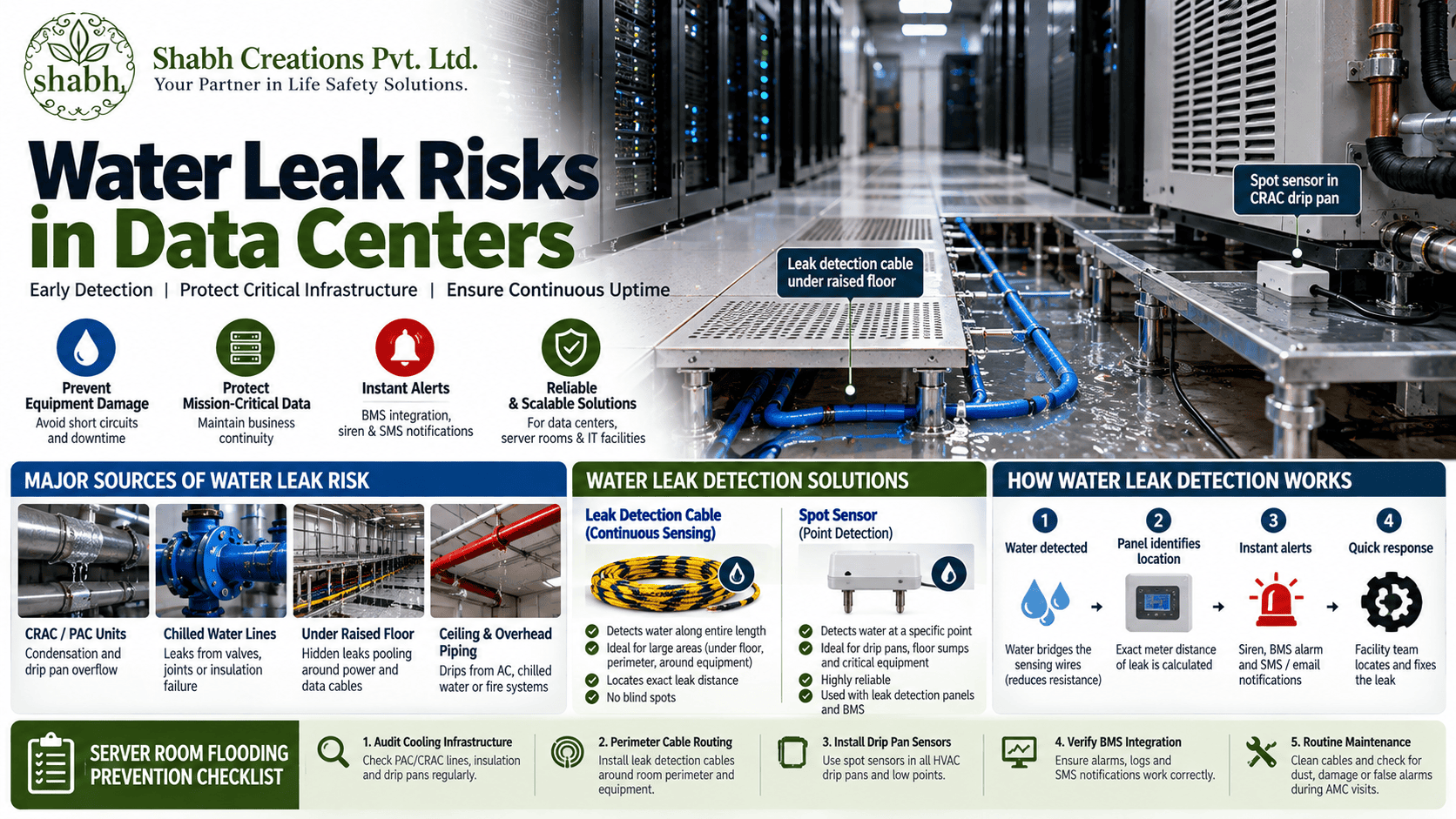
The primary water leak risks in data centers stem from Computer Room Air Conditioning (CRAC) units, overflowing condensation drip pans, and pressurized chilled water supply lines routed beneath raised IT floors. Because these voids are dark and rarely inspected manually, a minor slow drip can easily pool over time. If this water comes into contact with high-voltage power cables or server rack grounding components, it creates an immediate arc fault hazard, potentially destroying millions of dollars of equipment and triggering false fire alarms.
How Water Leak Detection Works
Modern environmental monitoring relies on intelligent, continuous electronic sensing rather than visual inspections.
Understanding how water leak detection works is straightforward: the technology relies on the principles of electrical conductivity. We install specialized sensing circuits that constantly monitor electrical resistance. Because water is conductive, the moment moisture bridges the gap between the internal sensing wires, the electrical resistance drops. The digital monitoring panel registers this sudden drop, calculates the exact mathematical distance of the fault along the circuit, and instantly triggers a facility-wide alert.
Water Leak Detection Cable vs Spot Sensor Applications
When designing your environmental defense network, facility managers must understand the exact differences in a water leak detection cable vs spot sensor comparison.
Spot Sensors (Point Detectors): Spot sensors consist of two metal probes that must be simultaneously touched by water to trigger an alarm. They are highly effective, but their coverage is extremely limited (typically a few square inches). A reliable contractor will deploy spot sensors in highly predictable pooling areas, such as directly inside a CRAC unit drip pan or at the lowest point of a floor drain.
Leak Detection Cables: For massive data halls, sensing cables are the gold standard. These flexible polymer cables detect moisture continuously along their entire length. Instead of trying to guess exactly where a pipe might burst, our expert engineers route these cables around the entire perimeter of the server room and zigzag them under the raised floor directly beneath the chilled water lines. This guarantees zero blind spots.
The Critical Need for a Water Leak Alarm for Server Racks
Detecting the water is only the first phase; the system must also execute an immediate, automated notification process.
If a condensation line bursts above a cabinet, a water leak alarm for server racks ensures your IT staff isn’t relying on a quiet buzzer inside an empty mechanical room. As your trusted supplier, we hardwire the localized leak detection module directly into your central Building Management System (BMS). When a leak is detected, the BMS instantly pushes digital SMS alerts to the facility management team, triggers a high-decibel siren at the security desk, and visually displays the exact floor tile location of the leak on the control interface, allowing for rapid intervention.
Server Room Flooding Prevention & Safety Checklist
To guarantee continuous uptime and total protection of your digital assets, our expert engineering team recommends implementing this rigorous server room flooding prevention checklist:
- Audit Cooling Infrastructure: Visually inspect all PAC/CRAC chilled water lines and ensure they are double-walled or thoroughly insulated to prevent exterior condensation dripping.
- Perimeter Cable Routing: Install continuous leak detection cables around the entire internal perimeter of the room and directly encircle all internal cooling units.
- Install Drip Pan Spot Sensors: Ensure reliable spot sensors are mounted inside all HVAC drip pans to provide an early warning before the pan actually overflows onto the IT floor.
- Verify BMS Digital Integration: Simulate a leak using a damp cloth on the sensing cable to mathematically verify that the BMS logs the exact meter distance and triggers the water leak alarm for server racks.
- Routine Maintenance Sweeps: During your Annual Maintenance Contract (AMC) visits, ask your trusted contractor to clean the sensing cables, as heavy dust buildup can trap ambient humidity and cause nuisance false alarms.
Frequently Asked Questions (FAQs)
What are the most common water leak risks in data centers?
The most frequent water leak risks in data centers include clogged HVAC condensation drains causing drip pans to overflow, ruptured chilled water supply lines under the raised floor, and external roof leaks that drip down onto the suspended false ceiling above the server racks. Protecting against these specific threats is a core recommendation of the National Fire Protection Association (NFPA 75).
In a water leak detection cable vs spot sensor design, can I use both?
Absolutely. In fact, a hybrid approach is the hallmark of a premier engineering design. An expert contractor will use spot sensors for targeted, high-risk drip pans, and continuous sensing cables to protect the sprawling, unpredictable area under the raised floor, ensuring compliance with the stringent facility standards enforced by the Bureau of Indian Standards (BIS).
How does a modern water leak alarm for server racks identify the leak’s location?
Modern digital panels utilize distance-read technology. By measuring the electrical resistance at the point where water touches the cable, the panel calculates the exact linear distance (e.g., “Leak detected at 24.5 meters”). The facility manager then cross-references this meter reading with a physical layout map to lift the exact floor tile where the water is pooling, minimizing response times.