Fire Pump System Explained: The Critical NFPA 20 Difference Between Jockey and Main Pumps
Fire Pump Systems Explained: Why Your Jockey Pump Matters More Than Your Main Pump
Most facility walkthroughs treat the fire pump room as a formality — a diesel engine and a big red pump, tested once a year, checked off the AMC list. That’s backwards. The component that actually determines whether your fire pump system holds pressure day to day isn’t the main pump at all. It’s the small one nobody looks at.
Understanding how a fire pump system actually works — not just that it exists — is the difference between a facility that passes inspections and one that would actually perform during a real fire. This guide breaks down the three-pump architecture, where these systems fail in practice, and what proper testing under NFPA 20 and NFPA 25 actually requires.
Understanding a Fire Pump System: Three Pumps, Three Jobs
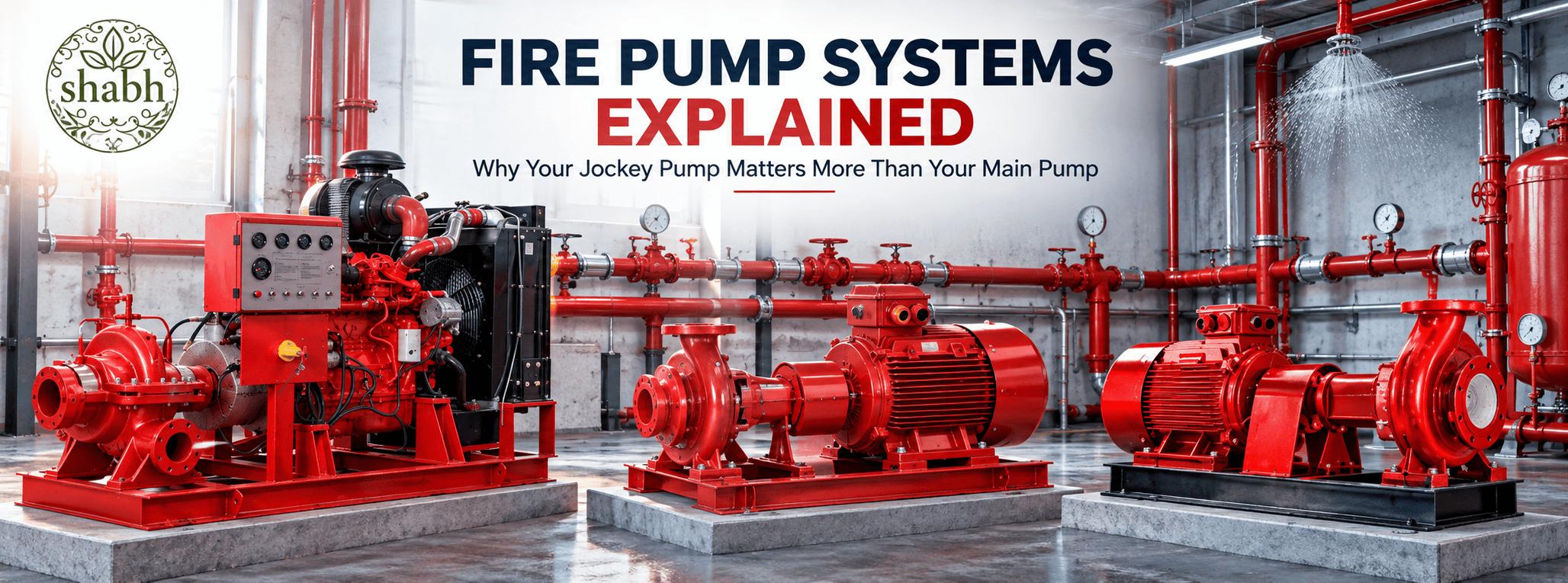
A properly designed fire pump system isn’t one pump — it’s three, each solving a different failure mode. Skipping any one of them, or treating them as interchangeable, is where most real-world problems start.
The jockey pump fire system:
is small, runs constantly (or cycles frequently), and does one job: top up minor pressure loss from small leaks, thermal expansion in the piping, or normal system weepage, so the main system never drops low enough to trigger the main pump for no real reason. Think of it as the pressure-maintenance pump — it’s not there to fight fires, it’s there to keep the system primed and ready so the main fire pump system never drops low enough to trigger the main pump.
If the jockey pump is undersized, faulty, or disabled, the main pump starts cycling on and off for trivial pressure dips. That’s a serious problem, because the main pump is engineered for sustained, full-flow operation during an emergency — not frequent start-stop cycling for routine pressure maintenance. Every unnecessary start wears down motor windings, mechanical seals, and starting components that are meant to be used rarely, at full demand, for extended periods.
The main pump:
(electric or diesel-driven) is the one sized to deliver the system’s actual design flow and pressure during a real fire event — enough water, at enough pressure, to reach the hydraulically most demanding sprinkler head or hydrant in the building, even during peak demand with multiple zones flowing simultaneously. Main pumps are typically horizontal split-case, vertical inline, or vertical turbine designs, chosen based on available suction conditions — a vertical turbine pump, for instance, is standard when drawing from a below-grade underground water storage tank, since it can lift water from a lower level than a horizontal pump can reliably prime.
The standby (diesel) pump:
exists for one scenario: the electric main pump can’t run because the building has lost power — which, not coincidentally, is a common condition during an actual fire, when electrical faults, breaker trips, or utility disruption are frequently part of the event itself. A diesel standby with its own starting battery, dedicated fuel supply, and independent controller is what keeps the system live when the electrical supply has failed entirely. This is why code requirements in high-risk or high-occupancy buildings typically call for a diesel pump as standby rather than relying solely on a generator-backed electric pump — a diesel fire pump’s fuel and starting system are dedicated and isolated from the building’s broader electrical infrastructure, removing a shared point of failure.
The controller: the fourth component people forget
Each pump in the fire pump system has its own dedicated controller — and the controllers matter as much as the pumps themselves. A fire pump controller isn’t a simple on/off switch; it’s designed to start the pump automatically on a pressure drop, run it continuously once started (fire pump controllers are built to run to destruction rather than shut off on a fault, since a false shutdown during an actual fire is far more dangerous than motor damage), and provide local and remote signaling of pump status, power failure, and phase-reversal faults. A controller that hasn’t been tested alongside the pump itself is only half-verified — a pump can be mechanically sound while its controller fails to start it automatically when required.
Where This Actually Breaks in the Field
In our audit work on fire pump systems across commercial and industrial facilities, the same handful of gaps show up repeatedly, and they’re rarely about the pumps being absent — they’re about the pumps being present but not functioning as a coordinated system.
- Jockey pump pressure switch set incorrectly. If the cut-in and cut-out pressures are set too close together, the pump short-cycles constantly, accelerating wear. If they’re set too far apart, the system pressure drifts low enough to trigger unnecessary main pump starts, which is the exact failure mode the jockey pump exists to prevent.
- Diesel standby pump with a dead starting battery. This is the single most common failure we encounter, and it’s almost never caught between annual tests — because the electric main pump has run successfully every time it’s been tested, nobody has actually needed the diesel standby to prove itself. A weekly no-load test run (standard practice under NFPA 25) is what catches a failing battery or fuel system before it matters.
Annual flow tests skipped, or done without proper flow measurement.
A pump that shows adequate pressure on a static gauge is not the same as a pump that delivers its rated flow under demand. Impeller wear, cavitation damage, or a partially clogged suction line can all reduce actual flow capacity while pressure readings look normal at no-flow or low-flow conditions. The only way to catch this is a proper flow test against the pump’s certified performance curve, using a flow meter or calibrated test header — not a five-minute “does it turn on and show pressure” check.
Pump room isolation valves left partially closed after maintenance. This is the same failure pattern we’ve flagged with sprinkler systems generally: a valve closed for a repair or inspection and never fully reopened afterward. A supervised valve (one with a tamper switch that reports status to the fire alarm panel) should catch this automatically — but only if that supervision is actually wired into the monitoring system and tested, rather than installed and forgotten.
Suction tank level and strainer condition ignored. A fire pump can only deliver what it can draw. A partially fouled suction strainer or a water storage tank that’s been allowed to sit at a lower operating level than design intent will starve the pump of flow long before the pump itself becomes the limiting factor.
NFPA 20 vs. NFPA 25 — Two Different Standards, Two Different Jobs
It’s worth being precise about which standard governs which part of a fire pump’s life cycle, since the two get conflated often:
NFPA 20 (Standard for the Installation of Stationary Pumps for Fire Protection) governs design and installation — pump sizing, suction conditions, controller specifications, and how the system is engineered before it’s ever put into service.
NFPA 25 (Standard for the Inspection, Testing, and Maintenance of Water-Based Fire Protection Systems) governs what happens after installation — the ongoing weekly, monthly, and annual testing regime that confirms the system still performs as designed. A pump correctly installed under NFPA 20 principles can still fail in practice if the NFPA 25 testing regime isn’t followed rigorously over the years that follow.
This distinction matters because a facility can genuinely have a well-designed fire pump system on paper and still be at real risk, simply because the maintenance side has lapsed. Design compliance and operational readiness are not the same thing, and an inspection that only checks design documents — without a witnessed flow test — verifies the wrong half of the system.
Why This Is Worth Understanding, Not Just Outsourcing
A fire pump system that starts and shows pressure on a gauge is not the same as one that can deliver its rated flow at rated pressure. The only way to know the difference is a proper annual flow test against the pump’s actual performance curve — not a static pressure check. This is standard maintenance-testing practice under NFPA 25, and it’s the single most commonly skipped item we see in facilities that otherwise consider themselves compliant.
Facility managers don’t need to become fire pump system engineers to ask the right questions of a service provider or an internal maintenance team: Has the jockey pump’s cycling frequency been reviewed recently? When was the diesel standby pump last flow-tested, not just started? Are the pump room isolation valves supervised and confirmed open? Those three questions alone surface most of the real-world gaps described above.
FAQ
Q: How often should a fire pump be flow tested?
Standard practice is an annual full flow test of the fire pump system against the pump’s rated performance curve, with more frequent basic operational checks — typically weekly for diesel pumps and monthly for electric pumps — in between, per NFPA 25.
Q: My jockey pump cycles on and off frequently — is that a problem?
Occasional cycling is normal. Frequent short-cycling usually means either a leak somewhere in the system or a pressure switch that’s set too tight — both are worth investigating, since either one accelerates wear on the jockey pump motor and can mask a slow leak that eventually becomes a larger problem.
Q: Do I need a diesel standby pump if my electric pump is on a backup generator?
A generator-backed electric pump can work, but it introduces a second point of failure — the generator itself and the transfer switch — that a dedicated diesel pump with its own fuel and battery doesn’t share with the building’s electrical system. Which approach is appropriate depends on your specific risk profile, occupancy classification, and applicable code requirements — this is a design decision made at the engineering stage, not a one-size-fits-all answer.
Q: What’s the most common reason a fire pump fails during an actual fire, despite passing inspections?
Based on what we see in the field, it’s usually one of two things: a diesel standby pump with a dead battery that nobody checked between annual tests, or a main pump that’s lost flow capacity over time — impeller wear, cavitation — but still shows adequate pressure on a static gauge, because pressure alone doesn’t confirm flow.
Q: Can a fire pump be too large for the system it’s protecting?
Yes. An oversized pump can actually create problems — excessive pressure that stresses piping and fittings, or a flow rate so high it causes cavitation at the pump’s minimum flow point. Correct sizing under NFPA 20 accounts for the building’s actual hydraulic demand, not simply the largest available pump.
Q: Who should perform the annual flow test — the AMC provider or an independent third party?
Either can be code-compliant, provided the test is properly witnessed, documented, and measured against the pump’s certified performance curve. Some facilities prefer an independent test annually alongside routine AMC servicing, specifically to avoid the same party that maintains the pump also being the sole party verifying its performance.
Shabh Creations Pvt. Ltd. provides fire and life safety consultancy, design, installation, and AMC services for commercial and industrial facilities across India. This article is general engineering guidance and does not constitute a site-specific assessment — pump sizing, testing frequency, and standby configuration should be verified against your facility’s actual hydraulic design and applicable code requirements.