Fire Safety System Handover: What a Quality Handover Process Must Include
Fire safety system handover
The installation team packs up, the completion certificate gets signed, and the building owner receives a set of keys and a binder. From that day, everyone assumes the fire alarm, the pumps, and the suppression systems work flawlessly. Often, nobody has actually proved it.
A fire safety system handover is the critical juncture where responsibility moves from the contractor to the facility owner. A weak handover leaves the owner holding a highly complex system they cannot verify, cannot modify, and cannot hold anyone accountable for. A quality handover process proves the hydraulic and electrical systems match the approved design, work exactly as intended, are fully documented, and are deeply understood by the facility management team.
This expert guide covers what a proper handover must include, the critical documents an owner must receive, and the hidden gaps that inevitably show up later during a municipal fire NOC inspection or, worse, during an actual thermal emergency.
What a Handover Is, and What It Isn’t
A handover is not simply a signature on a completion certificate. A signature merely records that the physical work was declared finished. A quality handover verifies four absolute truths:
- Design Alignment: The installed system mathematically matches the approved design in device count, locations, and hydraulic capacities.
- Operational Proof: Everything works. Components are tested individually and as a unified, reactive system.
- Documented History: Comprehensive records exist, ensuring the system can be maintained, modified, and audited.
- Operator Competence: The people who will operate the system can confidently do so without calling the contractor for every minor fault.
If any of these elements are missing, the handover is incomplete, regardless of what the paperwork claims.
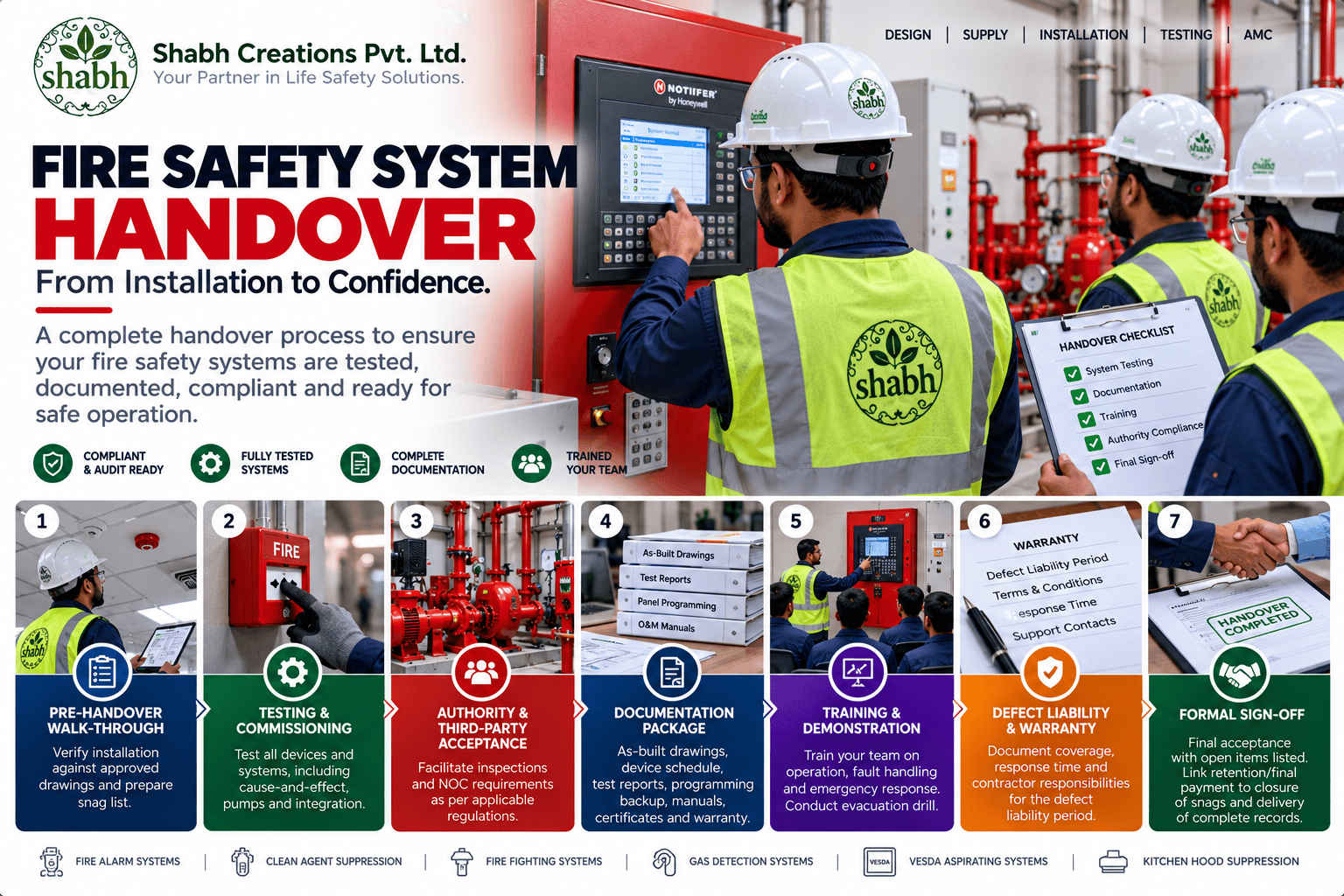
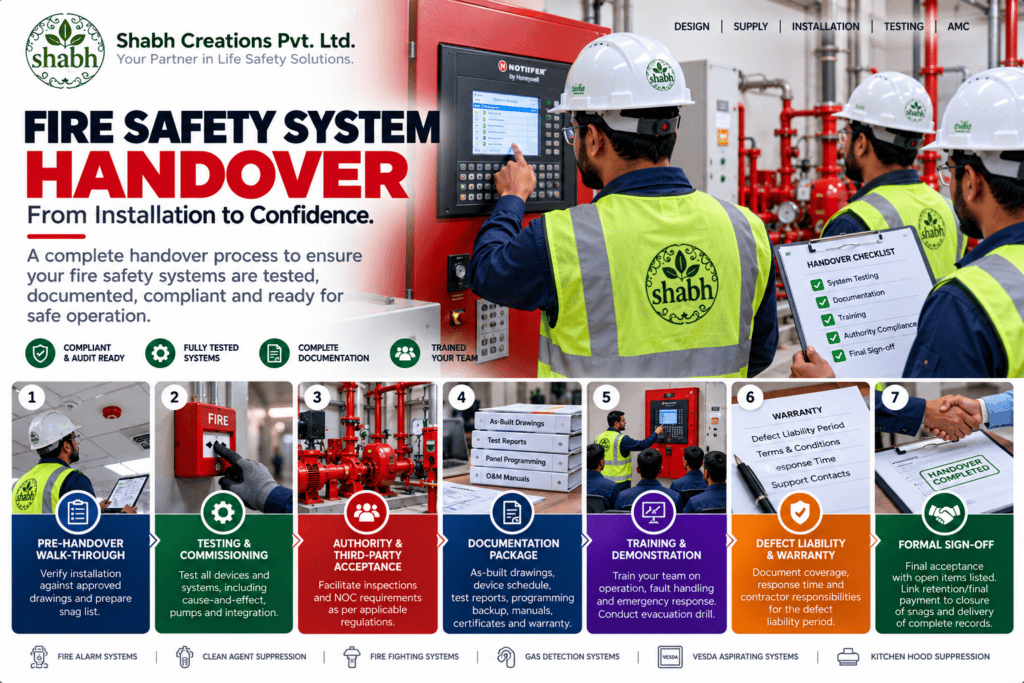
The Seven Stages of a Quality Handover
1. Pre-Handover Walk-Through and Snag List
Before formal testing begins, the owner’s representative, the expert consultant, and the reliable contractor walk the building with the approved architectural drawings. They verify that devices are installed exactly where the drawings indicate, correctly labeled, accessible, and not obstructed by later civil work (like false ceilings, partitions, or HVAC ducting). Every single defect is documented on a written snag list, complete with a specific location, description, and target resolution date. A defect agreed upon verbally is a defect forgotten.
2. Witnessed Testing and Commissioning
This is the phase where the system’s integrity is proven, and the owner or consultant must physically witness it. A proper test goes far beyond simply switching the panel on:
- Every smoke detector, manual call point, sounder, and control module is tested individually.
- Each activation is cross-checked against the cause-and-effect matrix: the correct hooters sound, air handling units (AHUs) shut down, elevators ground, access doors release, and signals reach the Building Management System (BMS).
- Standby lead-acid batteries are strictly load-tested, not just voltage-checked.
- Heavy-duty fire pumps are started via pipeline pressure drop and tested for exact flow and pressure against their rated performance curves.
- Gas suppression systems are tested safely, including release circuits, discharge indicators, and abort/hold functions, without actually discharging the expensive agent.
- Integration points (like BMS data links) are confirmed active on both sides.
Each test must produce a formally signed record, not a verbal “all clear.”
3. Authority and Third-Party Acceptance
Where the project dictates, an inspection by a third-party testing agency or the local fire authority follows. Requirements vary heavily by state, building height, and occupancy type. The handover schedule must be planned around this step so that fire NOC-related documents and municipal inspections are completed before the contractor demobilizes from the site.
4. The Complete Documentation Package
This is frequently the most neglected stage, yet it is the exact package an owner needs most in year three. A complete handover file must include:
- As-Built Drawings: CAD schematics showing what was actually installed, not the initial design drawings.
- Device Schedule & Zone Chart: A master list detailing each device’s specific address, location, and zone.
- Cause-and-Effect Matrix: The exact operational logic, as physically tested.
- Test and Commissioning Reports: Fully signed testing documentation.
- Panel Programming Backup: The raw configuration file and software version on a digital drive. This ensures a future trusted supplier can modify or restore the system.
- O&M Manuals: Operation and maintenance guides for every major equipment item.
- Equipment Data Sheets: Technical specifications and test certificates.
- Warranty Documents: Clear paperwork stating start dates and terms.
- Hydraulic Records: Fire-fighting pump flow and pressure test logs.
Without the programming backup and as-built drawings, a facility owner becomes entirely dependent on one supplier for every minor software change, creating massive commercial risk.
5. Training and Demonstration
The facility personnel responding to a panel fault at 2:00 AM must know exactly what they are looking at. Training must cover panel navigation (reading alarms, isolating zones safely, silencing, and resetting), fire pump room operations, manual overrides, and escalation contacts. Conducting a short, physical evacuation drill with the actual building staff proves whether the mechanical system and the human operators work effectively together.
6. Defect Liability and Warranty
The handover documentation must explicitly state the defect liability period (DLP), what it legally covers, and the contractor’s mandated response time for emergencies during this window. If these terms only exist buried in the original procurement contract, summarize them directly in the handover file so the on-site facilities team knows exactly who to call.
7. Formal Sign-Off with Open Items
The final acceptance document should list any remaining snags with assigned owners and hard closure dates, rather than being signed “clean” while physical defects remain. Many developers link the release of final retention payments to the absolute closure of this snag list and the delivery of the complete documentation package. This commercial leverage gives the contractor a clear incentive to finish the job flawlessly.
Red Flags in a Weak Handover
- Testing was executed by the contractor alone, with zero owner witnesses and no signed reports.
- Only the detectors were tested, completely ignoring the complex cause-and-effect matrix.
- Theoretical design drawings are handed over instead of accurate “as-built” schematics.
- The critical fire alarm panel configuration file is withheld.
- “Training” consisted of a ten-minute verbal chat with a security guard.
- Snags and defects were agreed upon verbally rather than documented.
- The subsequent Annual Maintenance Contract (AMC) begins without a baseline audit recording the system’s exact condition.
Why This Matters Later
Handover gaps rarely cause catastrophic trouble on day one. They surface later, usually at the worst possible times:
- At the Fire NOC Inspection: When municipal officers demand test certificates and as-built records that nobody can find.
- At the First Fault: When the alarm sounds, and no one on-site knows how to read the panel or who is responsible for the repair.
- At the First Fit-Out Modification: When the original contractor is unreachable, the configuration file is missing, and the panel must be entirely reprogrammed from scratch at a massive cost.
- During a Warranty Dispute: When the owner cannot legally prove when the warranty timeline actually began or what components were verified.
A handover is the cheapest, most effective time to find and fix these problems because the installation team is still on-site, the final payment is still pending, and the system architecture is fresh in everyone’s minds.
A Practical Owner’s Handover Checklist
- [ ] Walk-through completed against approved drawings, with a written snag list generated.
- [ ] All individual devices physically tested and recorded.
- [ ] Cause-and-effect matrix fully tested, verified, and signed off.
- [ ] Battery load tests and heavy-duty pump flow test reports received.
- [ ] Integration with BMS, elevators, AHUs, and access doors confirmed operational.
- [ ] Third-party or municipal authority acceptance completed (where legally required).
- [ ] As-built drawings, device schedules, and zone charts delivered.
- [ ] Fire alarm panel programming backup file received.
- [ ] O&M manuals, equipment data sheets, and certificates received.
- [ ] Warranty terms and defect liability periods explicitly documented.
- [ ] Facility operators trained and a live system drill conducted.
- [ ] Snag list fully closed, or remaining items listed with hard completion dates.
- [ ] AMC maintenance contract initiated with a comprehensive baseline condition record.
Frequently Asked Questions (FAQs)
What is a fire safety system handover?
It is the formal legal and operational transfer of an installed, fully tested fire protection network from the contractor to the facility owner, accompanied by all necessary documentation, training, and warranty terms.
What documents should I receive at handover?
At a minimum, you must receive: as-built CAD drawings, device schedules, the cause-and-effect matrix, signed commissioning reports, the panel configuration backup file, O&M manuals, equipment certificates, and all warranty documentation.
Why is the cause-and-effect test important at handover?
Because critical outputs—such as HVAC fan shutdowns, emergency door releases, and elevator grounding—can fail even if the smoke detectors work perfectly. These hidden automation failures only reveal themselves when the entire network is tested as a unified system.
Why do I need the panel programming backup?
Owning the digital configuration file ensures that another expert supplier can restore, upgrade, or modify the system if the original installation company becomes unavailable. Without this file, simple changes may require completely reprogramming the panel from scratch.
When should the maintenance contract start?
The AMC should begin immediately at or right after handover. It must start with a baseline audit that records the system’s exact condition, ensuring that any pre-existing installation faults are not confused with new maintenance issues.
(Shabh Creations Pvt. Ltd. provides expert fire and life safety consultancy, design, supply, installation, programming, testing, and comprehensive AMC services across India. This guide provides general engineering guidance. Specific handover requirements depend heavily on your project specifications, local municipal authority rules, and applicable NBC/NFPA standards.)