Expert Guide: Fire Alarm Faults Explained – Ground, Open, and Short Circuit
Ground fault in fire alarm system
A continuous, high-pitched beep emitting from your fire alarm control panel is a sound facility managers dread. However, that amber “Trouble” or “Fault” LED is not a random glitch; it is the system’s intelligent diagnostic reporting. Understanding the exact fire alarm trouble signal meaning is critical. It indicates that the system’s electrical integrity has been compromised, meaning it may fail to detect a real fire or sound the evacuation hooters when needed most.
As a trusted life safety contractor, Shabh Creations Pvt. Ltd. resolves hundreds of panel errors annually. In this expert guide, we break down the three most common electrical faults—open circuits, short circuits, and ground faults—and explore the root causes behind them.
1. The Open Circuit Fault Fire Alarm
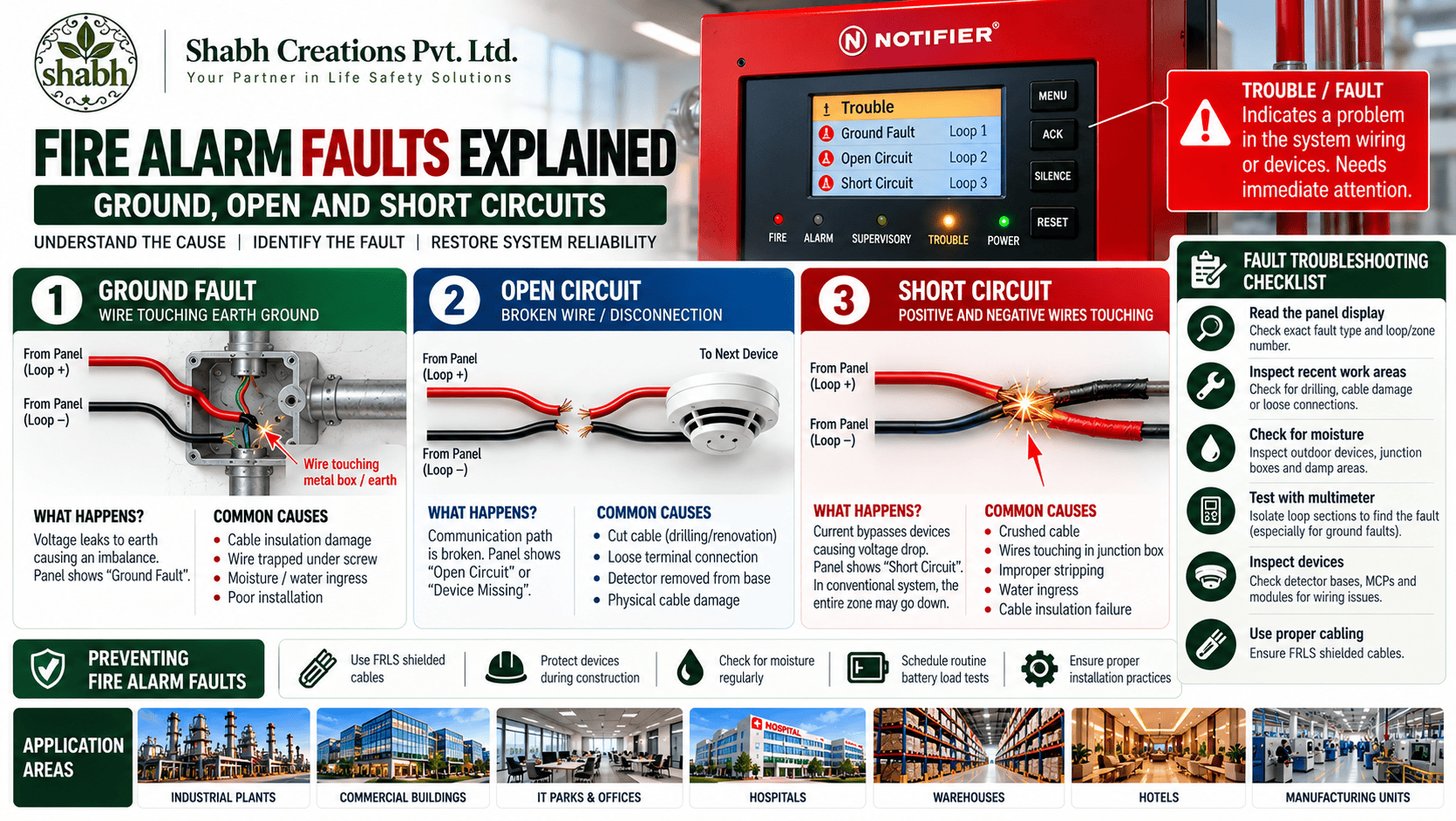
An open circuit fault fire alarm warning occurs when the continuous electrical path connecting the control panel to the field devices is broken.
Think of an open circuit like a bridge that has collapsed. Because the physical wire is severed, the digital polling data (or the monitoring voltage in conventional systems) cannot reach the detectors on the other side of the break.
Common Causes: This fault is most frequently caused by a physically cut cable (often due to other contractors drilling into ceilings), a loose wire slipping out of a detector’s terminal block, or a smoke detector head being physically removed from its base. As your reliable maintenance partner, our engineers trace the loop to find the exact point of disconnection and re-terminate the wiring to restore continuous communication.
2. Short Circuit Fault in Fire Alarm Loop
A short circuit fault in fire alarm loop is highly disruptive and requires immediate expert attention. This occurs when the positive and negative wires of the signaling line circuit come into direct physical contact with one another.
When a short circuit happens, the electrical current bypasses the field devices entirely and loops aggressively back to the panel, causing a massive voltage drop. In an older conventional system, a short circuit will instantly knock out the entire zone. In a modern addressable system, intelligent fault isolator modules will automatically trip, cutting off the shorted section to protect the rest of the loop and keep the majority of your building online.
Common Causes: Short circuits are typically caused by crushed cables, wires that were stripped too far during installation and are now touching inside a junction box, or severe water ingress melting the cable insulation.
3. Ground Fault in Fire Alarm System
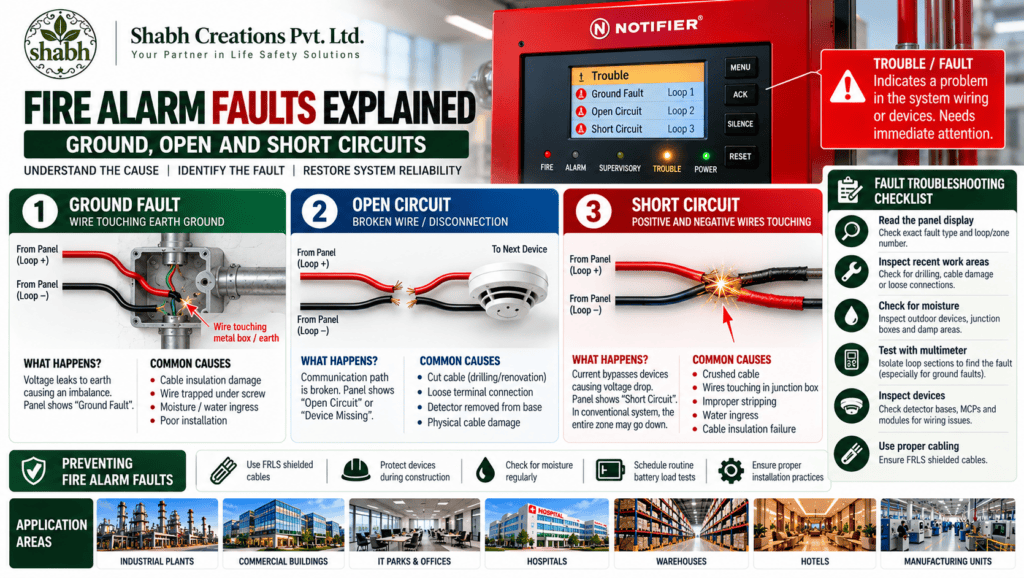
A ground fault in fire alarm system is notoriously the most difficult and frustrating error to trace. This fault occurs when an active, bare copper wire makes contact with “earth ground”—usually the metal conduit piping, a metal junction box, or the building’s structural steel.
Because the system voltage is slowly leaking into the earth rather than returning to the control panel, the panel detects a voltage imbalance and triggers the amber fault light.
Common Causes: Ground faults are almost always the result of poor installation practices. Cables scraped against sharp metal conduit edges during pulling, trapped wires under the screws of a metal backbox, or extreme moisture buildup inside external call points are the primary fire alarm panel fault causes when a ground fault appears. Tracing it requires isolating the loop segment by segment using a multimeter, a task that demands a highly skilled, reliable technician.
Preventing Major Fire Alarm Panel Fault Causes
Beyond basic electrical shorts, there are environmental fire alarm panel fault causes that can wreak havoc on your system.
Heavy dust accumulation inside an optical chamber will eventually trigger a “Dirty Sensor / Maintenance” fault. Aging Sealed Lead Acid (SLA) backup batteries will trigger a “Battery Fault” when they can no longer hold a charge under load. The best way to prevent these erratic troubles is to secure a comprehensive Annual Maintenance Contract (AMC). As a trusted supplier and life safety expert, we proactively test, clean, and monitor your system to eliminate faults before they compromise your facility’s NOC compliance.
Fault Troubleshooting & Prevention Checklist
To minimize system downtime and prevent electrical faults, our expert engineers recommend following this facility checklist:
- Never Ignore the Beep: If the panel is beeping, decipher the fire alarm trouble signal meaning on the LCD screen immediately. Silencing the buzzer does not fix the underlying hazard.
- Isolate Construction Zones: If third-party contractors are working in the ceiling, cover your smoke detectors with dust caps and monitor the loop carefully for accidental wire cuts (open circuits).
- Check for Moisture: Following heavy rain, inspect outdoor hooters and manual call points. Water ingress is the leading cause of sudden ground and short circuits.
- Use Proper Cabling: Ensure your installation contractor exclusively utilizes FRLS (Fire Retardant Low Smoke) shielded cables. Standard electrical wires are highly susceptible to electromagnetic interference and ground faults.
- Schedule Routine Battery Load Tests: Avoid sudden “Power Faults” by having your reliable supplier load-test and replace backup batteries every 2 to 3 years.
Frequently Asked Questions (FAQs)
Is a ground fault in fire alarm dangerous to the building’s occupants?
A ground fault itself does not mean a fire is occurring, but it is dangerous because it degrades the system’s communication loop. If left unresolved, a severe ground fault can prevent the panel from receiving an emergency signal from a triggered smoke detector, violating the safety protocols outlined by the National Fire Protection Association (NFPA).
What is the fastest way to find an open circuialarm?
In an addressable network, finding an open fault fire alarm is straightforward because the panel’s LCD will specifically list which numbered devices are “Missing.” In a conventional system, an expert technician must manually check the End-of-Line (EOL) resistor voltage across the zone to identify exactly where the cable continuity breaks, adhering to testing guidelines from the Bureau of Indian Standards (BIS).
How do isolator modules protect against a shfault in fire alarm loop?
Isolator modules act like digital circuit breakers. When a short circuit fault in fire alarm loop occurs, the isolators on either side of the short immediately open the circuit. This sacrifices the small group of damaged devices between them but preserves the voltage and functionality for the rest of the building’s loop. This failsafe architecture is heavily recommended by the Society of Fire Protection Engineers (SFPE).