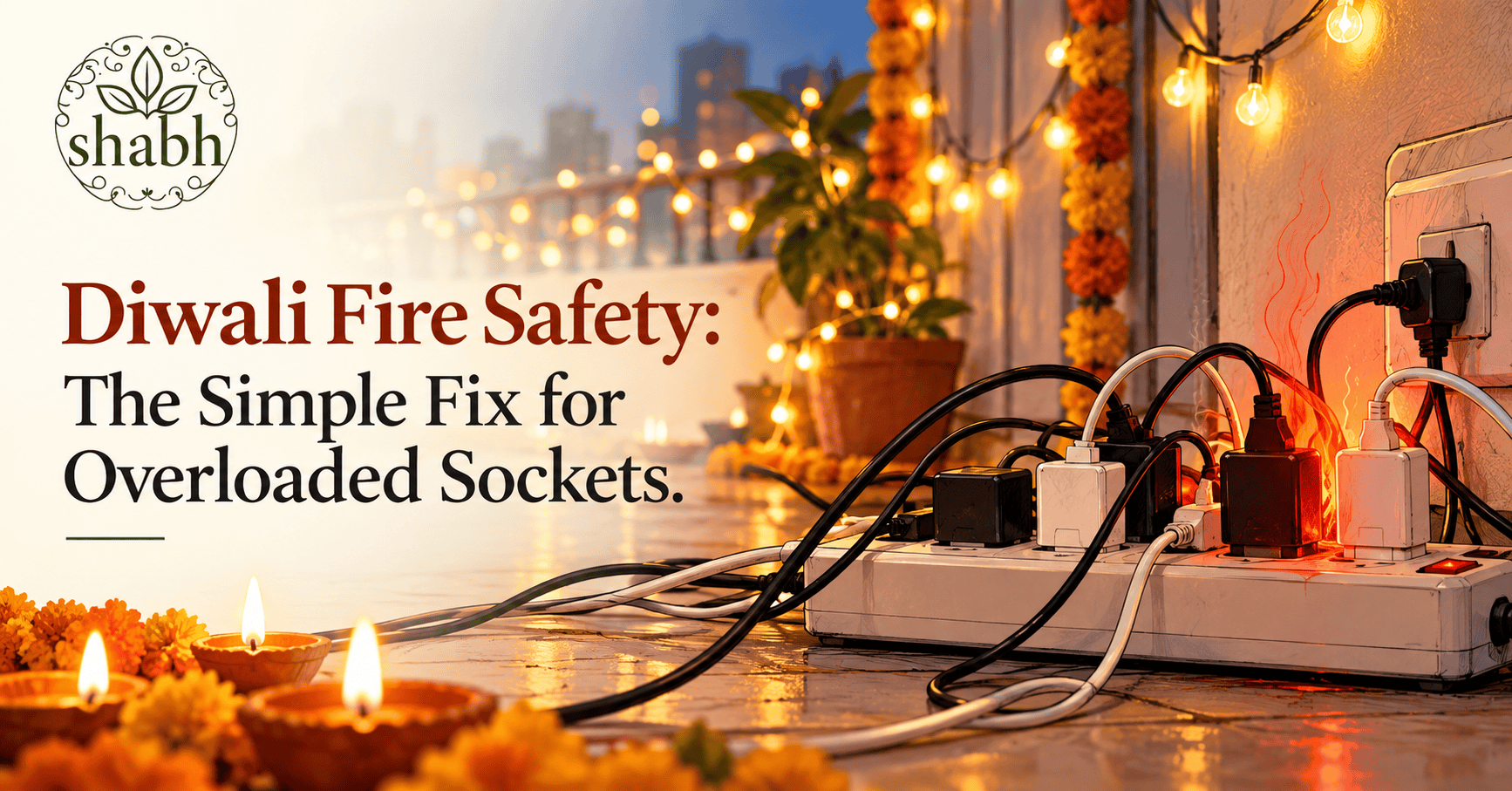
Diwali Fire Safety Tips: Decorate Without the Fire Risk.
Diwali Fire Safety Tips : The Simple Fix for Overloaded Sockets.
Diwali fire safety matters more than most people think during the one time of year every home turns into a showcase of lights — string lights wrapped around balconies, diyas lined along windowsills, fairy lights draped over furniture. It’s also the time of year electrical fires in homes spike sharply, and the reason is almost always preventable: too many lights plugged into too few sockets, left running for too many hours, on wiring that was never designed for the load.
Here’s a practical, no-jargon guide to decorating safely this Diwali — and what to actually do if something does go wrong.
Why Diwali Decorations Cause Home Fires
Most decorative lighting fires don’t come from a single dramatic failure. They build up quietly, from three everyday habits:
Overloading one socket.
A single wall socket or extension board is often asked to power string lights, a diya-shaped lamp, a decorative fountain, and a phone charger — all at once, for hours at a stretch. Every extension board has a maximum safe load printed on it (usually in watts or amps), and most people have never checked it.
Leaving lights on overnight.
Decorative lighting left running unattended for 10–12 hours generates heat in the wiring and connectors that never gets a chance to dissipate. A connector that’s slightly loose or a cheap extension board with poor internal contacts heats up progressively — and keeps heating up as long as current keeps flowing.
Using damaged or old lights.
String lights reused year after year often have cracked insulation, exposed copper at the plug end, or connectors that have loosened from repeated winding and unwinding. A fire doesn’t need a major fault — a tiny exposed wire touching a flammable curtain or paper decoration is enough.
Diwali Fire Safety Tips to Fix :
The Simple Fix for Overloaded Sockets
The good news is that the fix for all three habits above is straightforward and doesn’t require any technical knowledge:
Check the load before you plug in.
If you’re running string lights, a few diyas, and anything else off one extension board, keep the total well under the board’s rated capacity. When in doubt, split decorations across two separate sockets rather than daisy-chaining multiple extension boards off one point — chaining boards together is one of the most common causes of overheating, since the first board in the chain ends up carrying the combined load of everything plugged into the ones after it.
Turn decorative lights off.
when you’re not in the room, and always before sleeping. A smart plug with a timer (inexpensive and widely available) solves this automatically if you tend to forget — set it to switch off at a fixed hour every night.
Inspect lights before you hang them
not after. Unroll the full string and look for cracked plastic casing, discoloured or melted-looking sections near the plug, and any exposed wire. A string that’s been stored for a year and has a slightly brittle feel to the insulation is worth replacing rather than risking.
Keep decorations away from curtains, paper lanterns, and anything flammable.
This sounds obvious, but diyas and lit candles placed directly beneath hanging decorations or near window curtains are a recurring pattern in home fire incidents every festive season.
What About Diyas and Candles Specifically?
Real flame sources deserve their own attention, separate from electrical decorations:
- Place diyas on a stable, heat-resistant surface — not directly on fabric table runners or paper decorations.
- Keep diyas away from the edges of shelves or windowsills where a breeze or an accidental bump could tip them over.
- Never leave a lit diya unattended in a room with no one present, especially overnight.
- Keep a small bucket of sand or water nearby if you’re lighting multiple diyas — not as a dramatic precaution, just a sensible one that takes seconds to set up.
What a Home Fire Extinguisher Actually Needs to Handle
If you’re considering keeping a fire extinguisher at home for the festive season (a genuinely good idea, and one most homes skip), the type matters. A small multi-purpose dry powder extinguisher — commonly rated for electrical and general household fires — is the right choice for a home kitchen or living area. It’s compact, doesn’t require any training to operate correctly, and handles the two most likely home fire scenarios: an electrical fault and a small cooking fire. Keep it somewhere accessible, not buried in a cupboard, and check the pressure gauge once a year.
If a Fire Does Start
Switch off the power at the socket or the main switch first, if it’s safe and quick to reach — this matters most for an electrical fire, since water or a wet cloth on live wiring is dangerous. For a small, contained fire, smothering it with a fire blanket, a heavy damp cloth, or a dry powder extinguisher is far more effective than trying to pour water on it. If the fire is spreading or you’re unsure, leave the house immediately and call the fire department — don’t spend time trying to fight a fire that’s already grown beyond a small, contained flame.
FAQ
Q: How many string lights can I safely plug into one extension board?
Check the extension board’s rated wattage (printed on it) and keep your total load well under that limit — as a simple rule, avoid daisy-chaining more than one extension board off a single socket.
Q: Is it safe to leave Diwali lights on all night?
No. Turn decorative lighting off when unattended or before sleeping — a timer-enabled smart plug makes this effortless if you’re likely to forget.
Q: What type of fire extinguisher should I keep at home?
A small multi-purpose dry powder extinguisher, rated for both electrical and general fires, is the right choice for most homes.
Q: My string lights worked fine last year — do I still need to check them?
Yes. Insulation and internal connectors degrade with storage and repeated use, even if the lights still turn on. A quick visual check each year takes a minute and catches most risks before they matter.
Q: What should I do first if an electrical fire starts?
Cut power at the switch or socket if it’s safe and immediate to do so, then smother the fire with a blanket, damp cloth, or dry powder extinguisher — never water on an electrical fire. If it spreads, leave immediately and call for help.
Shabh Creations Pvt. Ltd. provides fire and life safety consultancy and compliance services for homes and businesses across India. This article is general safety guidance, not a substitute for professional inspection of your home’s electrical wiring or capacity.