Fire Alarm System Programming Explained: Why Cause-and-Effect Logic Design Decides If Your System Actually Works
Fire Alarm System Designing: 6 Proven Programming Steps:
Most facility managers assume a fire alarm system fails when hardware fails — a dead detector, a corroded contact, a panel that won’t boot. In our experience across manufacturing plants, data centres, and commercial high-rises, that’s rarely the real story. The systems that generate the most false alarms, burn through detectors in under two years, and leave operations teams silencing panels out of habit almost always have functioning hardware. What’s broken is the logic — the cause-and-effect programming that decides what the system is actually supposed to do, and why.
This is the part of fire safety and fire alarm system designing that gets treated as an afterthought: something a technician finishes after the panels are wired and the detectors are mounted. It shouldn’t be. Getting it right requires understanding how a building actually runs — its mechanical systems, its people’s habits, its hazard zones — before a single rule gets written.
Fire alarm system designing 101: what a cause-and-effect matrix actually is
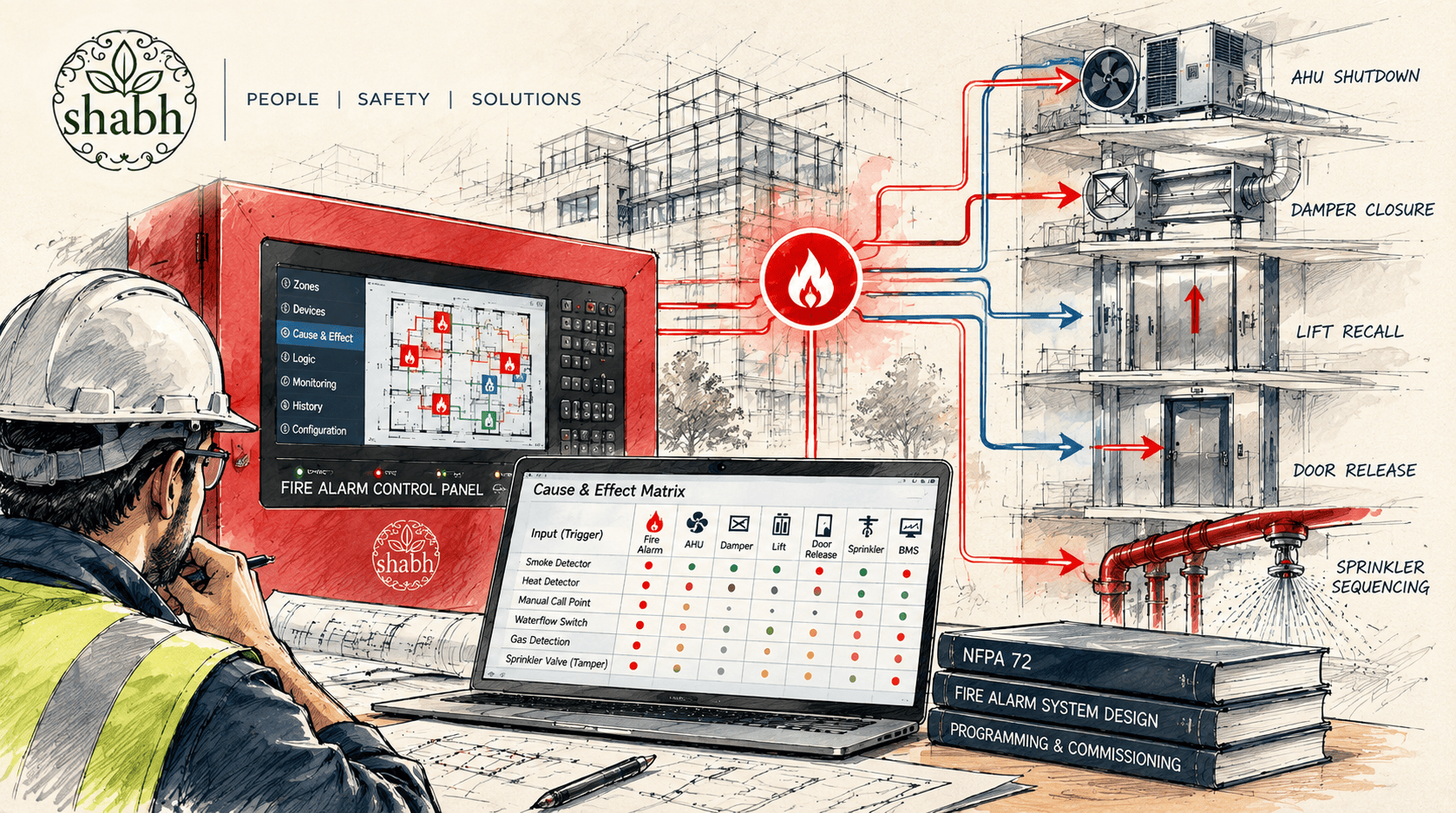
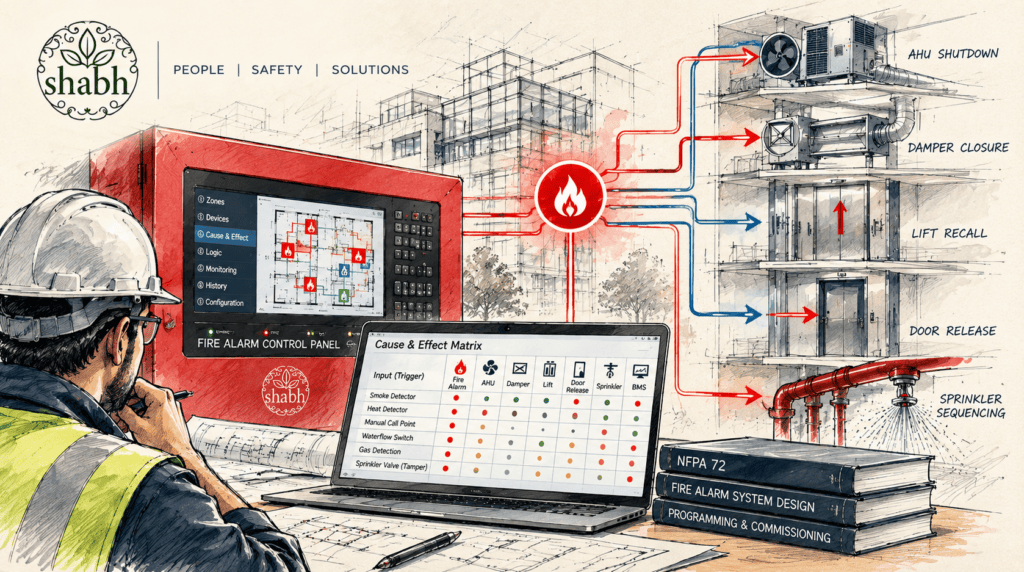
A cause-and-effect (C&E) matrix is the document that defines, for every possible trigger in a building, exactly what should happen next — and on a modern addressable fire alarm panel, that logic can be written down to the individual device, not just the zone. NFPA 72 requires this sequence of operations to be documented in matrix form for any non-trivial system: detector activation on one axis, system responses on the other — sounders, strobes, AHU shutdown, damper closure, elevator recall, door-holder release, suppression sequencing, BMS signalling.
On paper this looks like plumbing: input triggers output. In practice, a matrix built without understanding the facility it protects is a liability disguised as a compliance document. It technically satisfies the inspector. It does not actually protect the building.
Where generic fire alarm system programming falls apart
A panel programmer who only knows wiring diagrams can make a system pass commissioning. They cannot make it reliable, because reliability depends on variables that never show up on an electrical drawing:
- How access-controlled doors are actually used during a shift change, versus how the fire-and-life-safety drawing assumes they’re used
- Whether lift lobbies double as informal storage or smoking areas
- Which AHUs recirculate air between zones that should be smoke-compartmentalised
- Where door holders get manually wedged open because the automatic release is “annoying”
- Which pumps, motors, or boilers run unattended for hours and what their failure signatures look like
- What each room is actually used for today, as opposed to what its original occupancy classification says
- Where people already work around safety systems because the systems currently work against them
None of this is available from a P&ID or an electrical single-line. It only surfaces from walking the site, talking to the people who run it every day, and watching how the building actually behaves — not how the drawings say it should.
A real example: false alarms that weren’t about the detectors
One chemical processing client came to us with a recurring problem: fire alarm detectors in a specific process area were degrading and giving false alarms in under two years — far short of expected service life — and the plant had grown so used to nuisance alarms that operators had started treating every activation as noise rather than a signal.
The instinct in most facilities is to blame the hardware: replace the detectors, adjust sensitivity, move on. We did neither first. Our team spent time on the floor understanding the actual process — what ran when, what got vented when, and critically, what didn’t.
The root cause wasn’t the detectors at all. It was fumes and vapour from the process settling near the ceiling whenever the exhaust fan wasn’t switched on — which, in practice, was most of the time, because operators only turned it on once they personally felt the effects (burning eyes, irritation), by which point the vapour had already been sitting against the ceiling, coating and degrading the detection heads for hours.
The fix wasn’t a better detector. It was better logic: integrating the exhaust fans directly with fume and vapour detection, so the fans triggered automatically the moment vapour concentration rose — not when a person happened to notice discomfort. Since that change, the false alarms stopped and detector life returned to normal. The hardware never changed. The cause-and-effect logic did.
This is the difference between programming a panel and engineering a system. A programmer implements what’s specified. An engineer asks why the specification produces this outcome, and whether the actual operational behaviour of the facility — not its design intent — has been accounted for.
What this costs when it’s done wrong
Poorly designed cause-and-effect logic is expensive in ways that don’t show up on a single invoice:
- Detectors degrade early and get replaced repeatedly, inflating AMC costs, while the underlying cause goes unaddressed
- Repeated false alarms train staff to ignore or silence panels — the single most dangerous outcome a fire alarm system can produce, because it defeats its entire purpose
- Auditors and insurers increasingly look at alarm history, not just system presence; a high nuisance-alarm rate is itself a red flag during renewal
- Interlocks that were never properly mapped to actual equipment behaviour (AHUs, lifts, door holders, pumps) can fail silently until the day they’re needed
How this should actually be engineered
Proper cause-and-effect design is a sequence, not a wiring task:
- Walk the facility and document how it’s actually used, room by room — not just what the drawings say
- Interview operations staff about existing workarounds, recurring nuisance triggers, and equipment quirks
- Map every mechanical and electrical system that could plausibly interact with a fire event — AHUs, lifts, boilers, pumps, motors, access control, PA/speaker systems, electrical panels
- Classify occupational hazards per area, not per building, since risk profiles vary floor to floor and process to process
- Draft the cause-and-effect matrix against that operational reality, not against a generic template
- Test the logic against real failure scenarios before commissioning, not just against the checklist
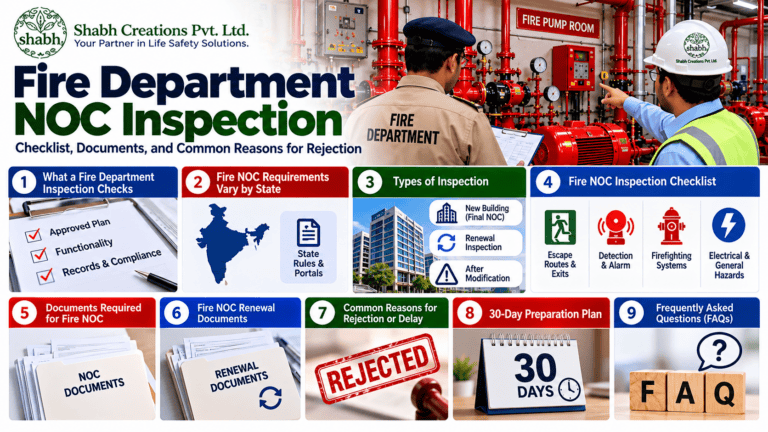
This is the work of a fire safety consultant before it’s the work of a panel programmer — understanding the facility comes first, and the code that runs the addressable fire alarm panel is the easy part by comparison.
FAQ
Why does my fire alarm keep going off when there’s no fire?
Repeated false alarms almost always trace back to a real condition being misread, not a faulty alarm — dust, steam, cooking smoke, or chemical fumes sitting near a detector, or programming that reacts to a single trigger instead of confirming it first. Chasing the detector rarely fixes it; finding what’s actually setting it off usually does.
Why do my detectors keep failing or needing replacement so often?
Can my fire alarm system turn things on automatically, like exhaust fans? Yes. This is standard practice — the fire alarm system can be set up to switch on exhaust fans, close dampers, or trigger other equipment the moment a relevant condition is detected, rather than waiting for someone to notice and react manually. It’s usually more reliable than depending on a person to catch it in time.
Does my factory or plant need a different fire alarm setup than a normal office building?
Yes. An office, a hospital, a data centre, and a chemical plant all have different risks, different equipment, and different day-to-day habits, so the logic behind the alarm system needs to be built around each one specifically — not copied from a standard template.
How do I know if the problem is my fire alarm’s programming, or just old equipment?
If you’re seeing repeated false alarms, detectors failing well before they should, or staff routinely muting or ignoring the panel, that’s usually a sign the underlying programming needs a proper review — not just a hardware swap.
Who should actually design my fire alarm system — an electrician, the vendor, or someone else?
Ideally, someone who understands both the technical side and how your facility actually operates day to day — a fire safety consultant, working alongside your operations team, your mechanical/electrical designers, and whoever installs the equipment. A vendor or electrician can wire and configure a panel correctly, but they usually aren’t the ones deciding what the system should actually do and why, and that decision shouldn’t be made in isolation from the people who run the building.
How does the programming inside an addressable fire alarm panel actually work?
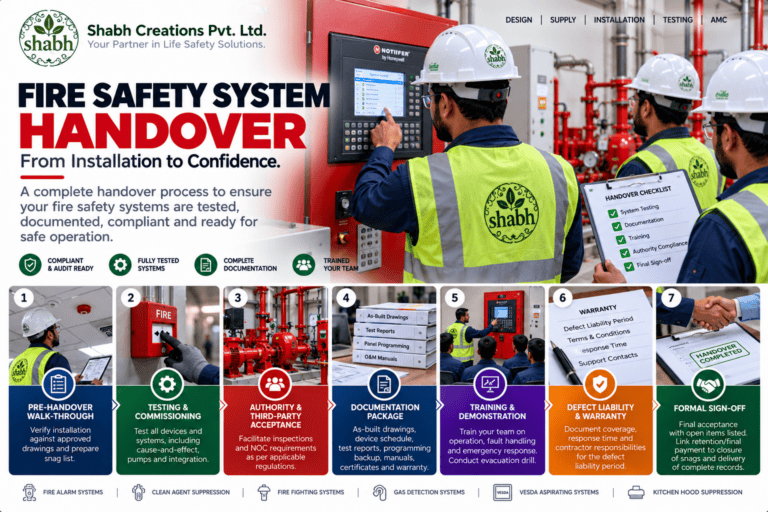
Every detector, call point, and device on an addressable panel has its own identity, so each one can be individually linked to a specific response — a sounder, a damper, a fan, a door release — instead of everything on a zone reacting the same way. That mapping is built into the panel’s own software and tested point by point before the system goes live.
Shabh Creations Private Limited works as a fire safety consultant and engineering partner across fire and life safety, electrical infrastructure, and critical infrastructure — covering the full project lifecycle from consultancy and fire alarm system designing through addressable fire alarm panel programming, supply, installation, testing, commissioning, and AMC. This article is general guidance and does not constitute site-specific fire safety advice; every facility’s cause-and-effect logic should be engineered against its own operational and hazard profile.