Expert Guide: Hydrogen Gas Hazards in Battery Rooms
Hydrogen gas hazards in battery rooms
Uninterruptible Power Supply (UPS) systems are the backbone of modern data centers, telecommunications hubs, and industrial manufacturing plants. While these massive battery banks guarantee business continuity during grid failures, they introduce a severe, invisible chemical threat to your facility. Addressing hydrogen gas hazards in battery rooms is a critical life safety mandate that cannot be ignored.
As a trusted life safety expert, Shabh Creations Pvt. Ltd. engineers advanced industrial gas detection and automated ventilation networks. In this comprehensive guide, we explore the science behind these invisible hazards and the precise engineering strategies required to safeguard your facility from catastrophic structural explosions.
The Hidden Threat of Lead Acid Battery Hydrogen Emission
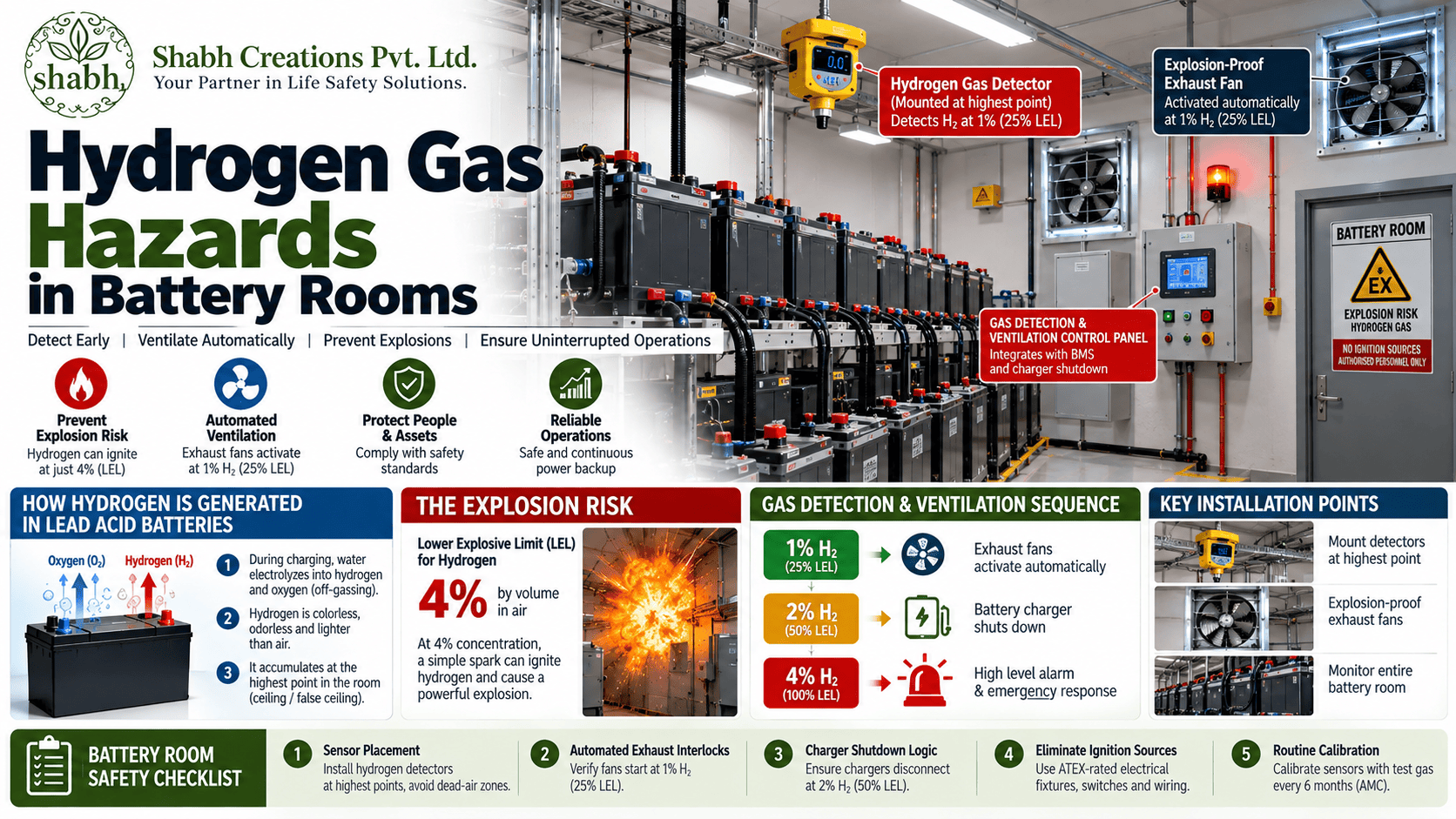
Whether your facility utilizes traditional flooded cells or modern Valve-Regulated Lead-Acid (VRLA) batteries, the chemical charging process inherently alters water into oxygen and hydrogen gas. This process is known in the industry as off-gassing.
The primary danger of lead acid battery hydrogen emission is that hydrogen is completely colorless, odorless, and tasteless. Without highly sensitive, permanent electronic gas detection systems, your facility staff will have absolutely no warning that a massive, highly flammable gas cloud is rapidly accumulating inside the sealed UPS enclosure during a heavy charging cycle.
Understanding the Hydrogen Explosion Risk UPS Batteries
Hydrogen is the lightest element on earth. The moment it escapes the battery casing, it shoots directly upward, pooling at the highest point in the room, above suspended ceilings, or trapped between structural joists.
The hydrogen explosion risk UPS batteries present becomes critical when the gas reaches its Lower Explosive Limit (LEL), which is just 4% concentration by volume in the air. At this incredibly low threshold, a simple static spark, an arc from an electrical relay, or even turning on a standard light switch can ignite the gas cloud. The resulting volumetric explosion is powerful enough to blow out concrete walls and permanently destroy millions of dollars of surrounding IT infrastructure.
Strict Battery Room Ventilation Requirements
Preventing this catastrophic scenario requires a proactive combination of active gas detection and advanced mechanical exhaust engineering.
To maintain a sterile, safe environment, facility managers must adhere to strict battery room ventilation requirements. A reliable contractor will engineer a system where ceiling-mounted hydrogen sensors are hardwired directly to explosion-proof exhaust fans. The moment the sensors detect hydrogen at just 1% volume (only 25% of the explosive limit), the control panel automatically activates the fans. This forcefully extracts the hazardous gas out of the building long before it can ever approach dangerous, explosive levels.
Implementing a Code-Compliant Battery Room Safety Checklist
To ensure your facility passes its municipal safety audits and commercial insurance inspections on the first attempt, our expert engineers recommend implementing this strict battery room safety checklist:
- Sensor Placement Audit: Physically verify that hydrogen sensors are mounted at the absolute highest peaks of the ceiling, avoiding any dead-air zones where rising hydrogen might be missed.
- Automated Exhaust Interlocks: Safely test the control panel to ensure it automatically triggers the mechanical exhaust fans the moment gas reaches a 1% concentration (25% LEL).
- Charger Shutdown Logic: Program the safety network to instantly disconnect power to the battery charging current if the gas concentration reaches 2% (50% LEL), halting the chemical emission at its source.
- Eliminate Ignition Sources: Ensure all lighting fixtures, electrical switches, and wiring conduits within the battery room are ATEX-rated and fully explosion-proof.
- Routine Sensor Calibration: Engage a reliable supplier for an Annual Maintenance Contract (AMC) to digitally recalibrate the hydrogen sensors with precision test gas every six months, preventing dangerous sensor drift.
Frequently Asked Questions (FAQs)
Do VRLA (sealed) batteries pose a lead acid battery hydrogen emission risk?
Even though VRLA batteries are designed to recombine most of the hydrogen and oxygen internally, they still feature pressure relief valves. During heavy charging, equalization, or thermal runaway, these valves open and vent gas into the room, creating a significant lead acid battery hydrogen emission hazard. Continuous monitoring is still mandated per Institute of Electrical and Electronics Engineers (IEEE 1635) standards regardless of the battery type.
What do global battery room ventilation requirements mandate for airflow?
Proper battery room ventilation requirements dictate that the mechanical exhaust system must provide enough air exchanges per hour to keep the absolute maximum hydrogen concentration below 1% under worst-case charging conditions. This strict safety protocol is heavily enforced by the National Fire Protection Association (NFPA 1 & 70E) to guarantee human safety and structural integrity.
How do engineers mitigate the hydrogen explosion risk UPS batteries create?
The most effective way to eliminate the hydrogen explosion risk UPS batteries pose is through intelligent control panel interlocks. A trusted supplier will integrate the gas detectors to automatically shut down the battery charging current if gas levels rise. This stops the chemical off-gassing reaction at the source before an explosion can occur, aligning perfectly with Bureau of Indian Standards (BIS) industrial safety codes.