Infrared Thermography for Electrical Panels: What It Checks, How It’s Done, and How Often You Need It
Infrared Thermography Electrical Panel Inspection : What It Checks, How It’s Done, and How Often You Need It
A loose connection inside a live electrical panels doesn’t announce itself. It doesn’t trip a breaker, doesn’t smell, and doesn’t show up on a visual walk-through. It just quietly heats up — for days, weeks, sometimes months — until it either fails or ignites. By the time either happens, it’s no longer a maintenance item; it’s an incident report.
Infrared thermography is the tool built specifically to catch that gap: it sees heat that’s already there, long before a fault becomes visible any other way. This guide covers what a proper thermographic inspection actually checks, the standard that now governs how often it should happen, a step-by-step breakdown of the process, and a practical severity checklist facility teams can use to judge what they find.
What Is Infrared Thermography Electrical Panel Inspection?
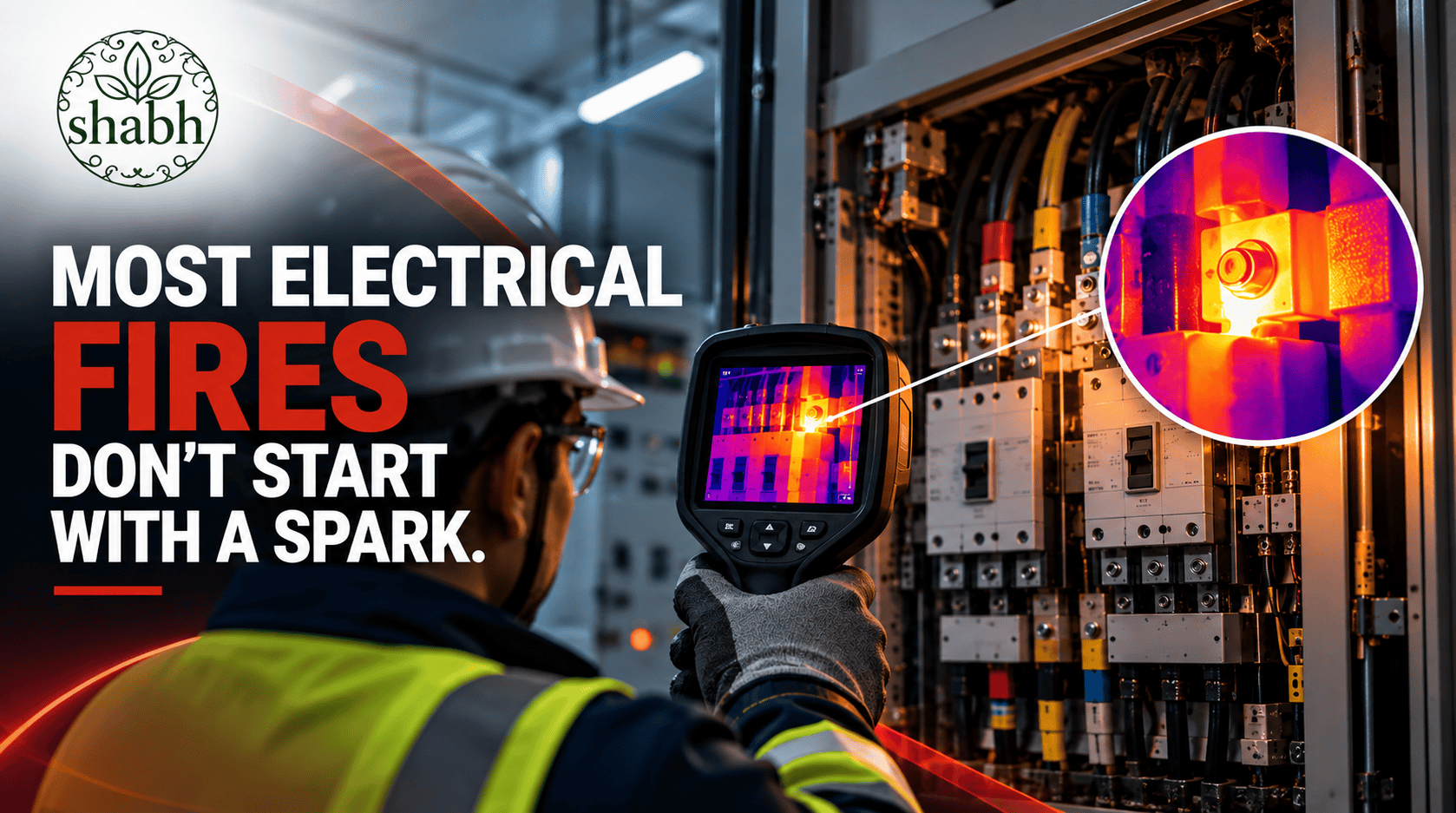
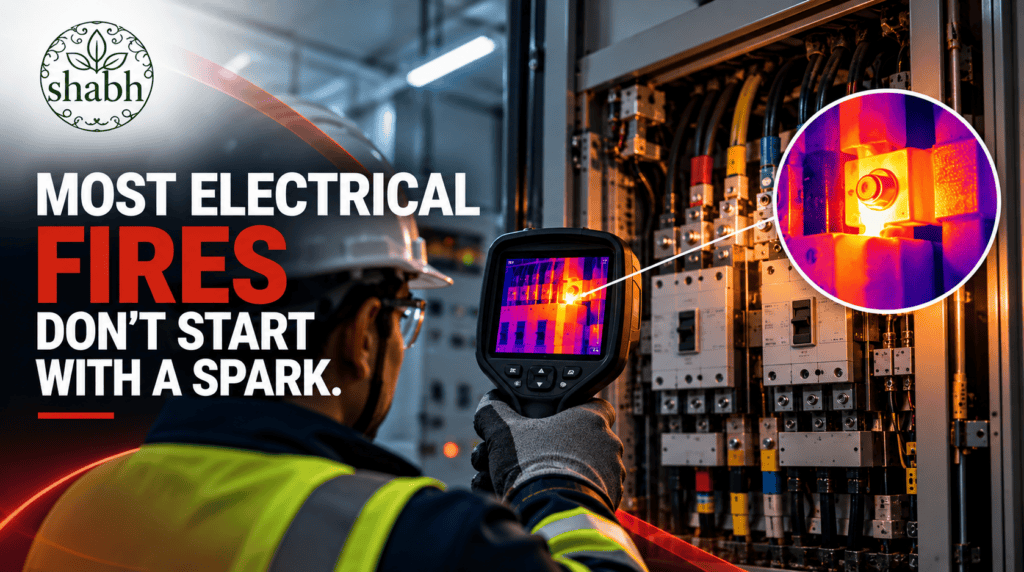
Infrared (IR) thermography uses a calibrated thermal camera to measure the surface temperature of electrical equipment while it’s live and under load. Every electrical connection carries a small amount of resistance; when a connection loosens, corrodes, or is undersized for its load, that resistance — and the heat it generates — rises sharply at that exact point, while the rest of the circuit stays normal. The camera makes that localized heat visible as a clear hotspot against its surroundings, in a scan that takes seconds and requires no shutdown.
It’s a non-invasive, non-contact inspection method. Nothing is switched off, nothing is disassembled, and the equipment keeps running throughout.
Why This Has Become a Predictive Maintenance Priority
Traditional electrical maintenance is often reactive or calendar-based: replace what’s due, inspect what’s scheduled, respond when something fails. Thermography shifts that to condition-based maintenance — acting on what the equipment is actually telling you right now, rather than what a fixed calendar assumes.
That shift matters more as facilities run harder. HT/LT electrical panels, UPS systems, and distribution boards in data centres, manufacturing plants, and commercial buildings increasingly run at higher, more continuous loads than they were designed around a decade ago. Higher sustained load means a marginal connection fails faster — and a facility running 24/7 has no maintenance window to discover that the hard way.
The Standard Behind It: NFPA 70B
NFPA 70B — the Standard for Electrical Equipment Maintenance, published by the US National Fire Protection Association — is the reference document most professional electrical preventive maintenance (EPM) programs are built around, including in India, where NFPA standards are already widely used as the technical basis for testing methodology on other systems (fire pumps to NFPA 20/25, for instance).
Its 2023 revision made a significant change: infrared thermographic inspection moved from a recommended practice to a mandatory one. Under the current edition:
- All electrical equipment requires thermographic inspection at least every 12 months.
- Equipment assessed as being in degraded physical condition (Condition 3) — visible wear, prior repairs, signs of stress — requires inspection at least every 6 months.
- Inspections must be carried out under normal or near-normal load, since a fault can look mild at partial load and severe at full load.
- The person conducting the inspection is expected to be qualified on the equipment and the thermal imaging equipment being used.
It’s worth being precise here: NFPA 70B is not Indian law, and there is no single central Indian statute mandating IR thermography on a fixed schedule. It functions in India the way it does elsewhere — as the technical benchmark serious electrical maintenance programs, insurers, and audit bodies increasingly expect facilities to follow, rather than as its own regulatory requirement. Check your own insurance and any facility-specific compliance requirements for what’s actually mandated in your case.
What a Professional IR Electrical Survey Actually Checks
A proper survey covers every point in a system where current has to pass through a joint or a connection, since that’s where resistance — and therefore heat — concentrates. Typical scope includes:
- Main and distribution switchgear, and breaker panels
- Motor control centres (MCCs)
- Disconnect switches and isolators
- Bus duct and busbar joints
- Transformer bushings, terminals, and tank surfaces
- Capacitor banks
- Fuse holders and clips
- Cable trays, terminations, and lugs
- UPS and battery terminal connections
What it typically finds, in order of how often each shows up: loose or deteriorated bolted connections and crimped lugs (the single most common finding in most surveys), corroded terminals, overloaded circuits and conductors, and phase imbalance — where one phase of a three-phase system runs measurably hotter than the other two, often a sign of uneven loading, harmonic distortion, or a developing single-phase fault.
Step-by-Step: How a Compliant Thermographic Inspection Is Conducted
- Confirm load conditions before scanning. This is non-negotiable — a connection showing a mild rise at 60% load can show a severe rise at full load. A scan without recorded load data can’t be judged for severity.
- Establish a reference temperature. This is either the surrounding ambient air, or an equivalent healthy component under the same load (e.g., comparing one phase to the other two).
- Access the equipment safely. Where electrical panels covers can be removed live under proper procedure, they are; where that’s not safe, pre-installed IR viewing windows allow scanning without opening the electrical panels at all.
- Scan systematically. Every connection point in scope gets scanned — not only the ones that look worn on visual inspection, since thermal faults are frequently invisible to the eye until they’re already severe.
- Record the load current at the time of the scan, alongside the thermal images, for every finding.
- Classify each anomaly by its temperature rise (ΔT) above the reference, using a recognized severity scale (see below).
- Document with both thermal and visual photographs, tagged to the exact equipment and location.
- Issue a prioritized report — findings ranked by severity and urgency, not a raw folder of thermal images with no interpretation.
- Re-scan after any corrective repair to confirm the fix actually resolved the anomaly, rather than assuming it did.
A Practical Severity Checklist
Once a temperature rise (ΔT) above reference is measured, the widely used NETA-style classification gives a rough guide to urgency. Exact cut-offs vary slightly between standards and thermographers, but the shape is consistent:
- 1–10°C rise — Monitor. Early-stage finding; note it and re-check at the next scheduled scan.
- 11–20°C rise — Plan repair. A developing problem; schedule the fix at the next available opportunity rather than waiting for the next annual cycle.
- 21–40°C rise — Repair as soon as possible. A confirmed deficiency; reduce load on that circuit if feasible while the repair is arranged.
- Above 40°C rise — Immediate action. Treat as an active failure risk; this is the range most associated with imminent connection failure.
The principle that matters more than the exact numbers: the higher the rise above reference, the less time there is before that connection fails on its own terms rather than yours.
What Thermography Won’t Catch
It’s worth being honest about the limits, since no single method covers everything. Thermography detects heat that’s already being generated — it can’t see through sealed or inaccessible equipment, it won’t catch insulation breakdown before that breakdown starts producing heat, and it won’t catch a fault that happens to be inactive at the moment of the scan. It’s a strong complement to — not a replacement for — insulation resistance testing, circuit breaker testing, and a full physical fire and electrical safety audit. Facilities get the most value treating it as one layer in a broader condition-monitoring program, not a standalone check.
Building It Into an Ongoing Maintenance Program
A single thermographic survey is a snapshot. The value compounds when it’s repeated on a fixed schedule, findings are tracked over time rather than treated as one-off, and it’s folded into the facility’s existing AMC scope so corrective work has an owner and a timeline rather than sitting in a report nobody revisits. It should be carried out by someone qualified on both the equipment type and the thermal imaging technology itself — the camera only produces a useful result in the hands of someone who knows what a genuine anomaly looks like versus a reflection or an emissivity error.
Frequently Asked Questions
What is infrared thermography in electrical maintenance?
It’s a non-contact inspection method that uses a thermal camera to detect abnormal heat at electrical connections and components while the equipment is live and under load, revealing faults like loose connections or overloading before they cause a failure.
How often should electrical panels be thermographically inspected?
The commonly followed benchmark, from NFPA 70B’s 2023 revision, is at least once every 12 months for all electrical equipment, and at least every 6 months for equipment already showing degraded physical condition. This isn’t an Indian statutory requirement on its own, but it’s the standard most professional maintenance programs work to.
Can thermography be done without shutting down the power?
Yes — that’s one of its main advantages. The scan is done on live, energized equipment under normal operating load, since the inspection specifically depends on the equipment being under load to reveal heat-related faults.
What temperature rise is considered dangerous?
As a general guide, a rise above 40°C over the reference temperature is treated as an immediate action item by most severity classifications, while smaller rises (1–20°C) are typically monitored or scheduled for repair rather than treated as urgent. The trend and the specific equipment matter as much as the single number.
Is infrared thermography legally required in India?
There’s no single central Indian law mandating it on a fixed schedule. It’s followed as an industry best practice, often expected by insurers and increasingly built into professional AMC and audit scopes, rather than enforced as its own standalone regulation.
Who should carry out an infrared electrical survey?
Someone trained and experienced both in the electrical equipment being inspected and in using calibrated thermal imaging equipment correctly — interpreting a thermal image requires understanding load conditions, emissivity, and reference temperatures, not just pointing a camera at a electrical panels.
This article is provided by Shabh Creations Private Limited for general informational purposes and reflects publicly available technical and regulatory information as of September 2026. It is not a substitute for a site-specific electrical inspection — equipment condition, load profiles, and applicable requirements vary by facility, and a qualified professional should assess your specific installation before you rely on any of the above for maintenance or compliance decisions.