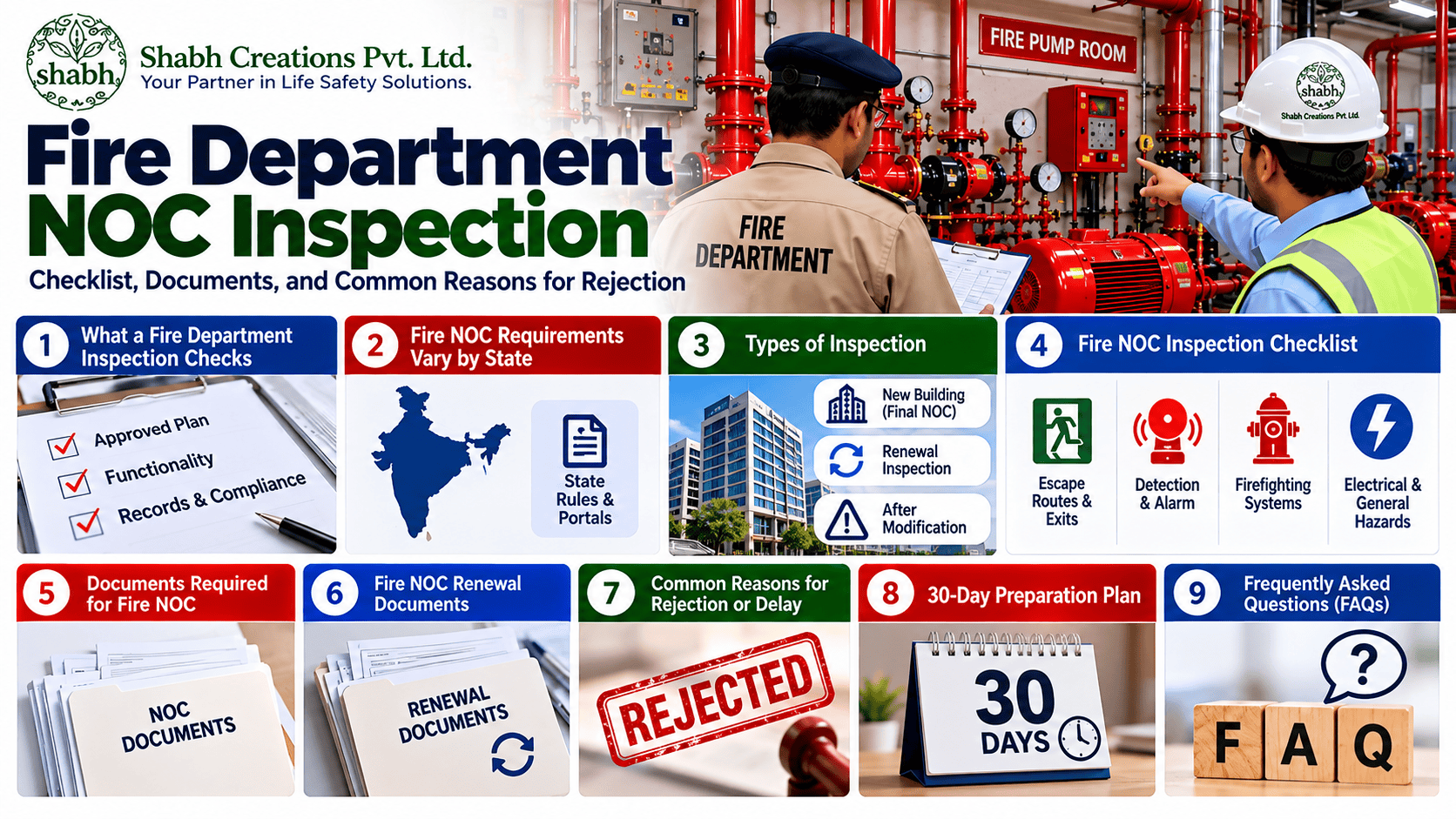
How to Prepare for a Fire Department NOC Inspection: Checklist, Documents, and Common Reasons for Rejection
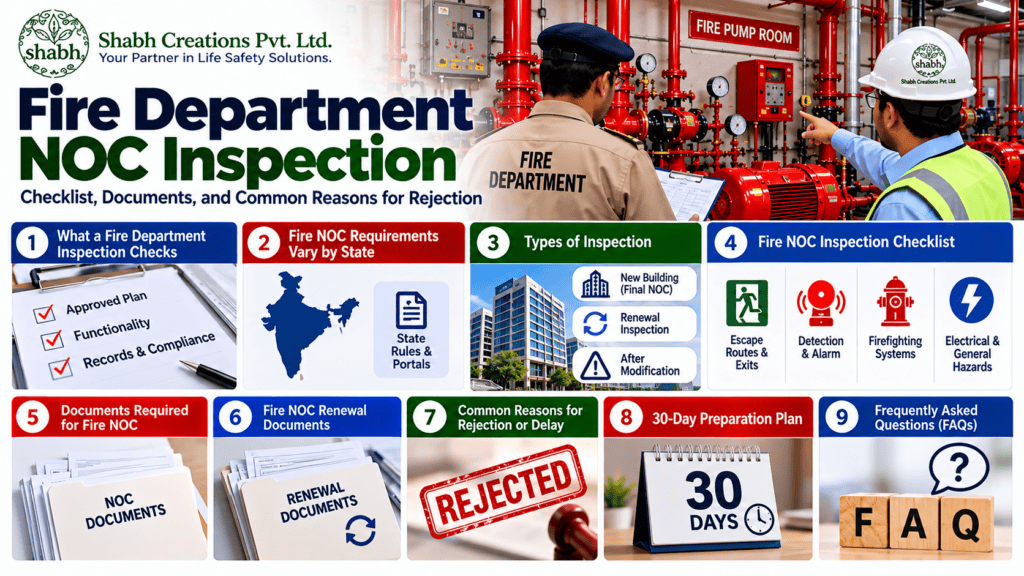
Fire NOC Inspection Checklist, Documents, and Common Reasons for Rejection
A fire officer walks into your building. They don’t read the file first. They go to the pump room, press a manual call point, try the staircase door, and check whether the extinguisher gauge is in the green. Most buildings that struggle at a fire NOC inspection aren’t missing equipment. They have equipment that doesn’t work, records that don’t match what was approved, or exits that were blocked the week before.
This guide covers how to prepare for a fire noc inspection (checklist): what the inspector checks, the documents required for a fire NOC, what changes at renewal, and the most common reasons a fire NOC is rejected or held back.
First, a Caveat: Requirements Vary by State
A fire NOC is issued by the state or local fire authority, so the exact rules, forms, fees, and document lists differ across states and building categories. In Haryana, for example, the Haryana Fire Service Act, 2009 requires a fire NOC for non-residential buildings and for residential buildings above 15 metres, while other states set their own thresholds and portals. Many states now run the application online. Use this guide to prepare, and check your own fire department’s current fire noc inspection checklist before you apply or renew.
What a Fire Department Inspection Actually Checks
An inspection usually tests three things:
- Does the building match the approved fire-fighting plan? Installed systems, extinguisher locations, exits, and water storage should match what was submitted.
- Does everything work? Officers commonly ask to see systems operated, not just present.
- Do the records support it? Test certificates, service reports, and drill records show the systems are maintained, not just installed.
A gap in any one of these can delay or block the certificate.
Fire NOC Inspection Checklist: What to Check Before the Officer Arrives
Walk the building yourself, floor by floor, with this fire noc inspection checklist
Escape routes and exits
- Every exit and staircase is unlocked, unobstructed, and free of stored material
- Exit signs are visible and illuminated
- Emergency lighting works when mains power is switched off
- Fire doors close fully and latch, and aren’t wedged open
Detection and alarm
- The fire alarm panel shows no active faults or disabled zones
- Detectors and manual call points are in place and tested
- Hooters sound audibly across all floors
- Where the system is linked to other functions, such as lift recall or ventilation shutdown, these respond correctly
Firefighting systems
- Extinguishers are present at the approved locations, with gauges in the green, seals intact, and valid service dates
- Hose reels and hydrants are accessible, with hoses and nozzles in place
- Sprinkler heads are unobstructed and valves are open
- The fire pump set starts automatically, builds pressure, and the diesel pump has fuel and a charged battery
- Fire water tank levels match the approved storage capacity
- Wet riser or yard hydrant connections are accessible
Electrical and general hazards
- Panels and distribution boards are clear of storage, with no overloaded extension boards
- Kitchens, LPG storage, and flammable materials are stored and segregated as required
- No unauthorised additions, such as partitions or mezzanines, block detectors, sprinklers, or exits
Documents Required for Fire NOC as per fire noc inspection checklist
The exact list depends on your state and building type, but applicants are commonly asked for items like these:
- Completed application form (online on most state portals) and the prescribed fee receipt, where fees apply
- Proof of ownership or a lease agreement
- Sanctioned building plan, and completion or occupancy certificate where applicable
- Fire-fighting layout or scheme drawings showing detectors, extinguishers, hydrants, sprinklers, and exits
- Installation completion and test certificates for the alarm and firefighting systems
- Maintenance records or an AMC (annual maintenance contract) with service reports
- Electrical safety or other supporting certificates, where the authority requires them
- Details of trained fire staff and fire drill records, for buildings that need them
Keep everything in one indexed file, with copies ready on site on inspection day. Names, addresses, and built-up areas should match across every document. Inconsistencies are a frequent cause of queries.
Fire NOC Renewal Documents
Renewals usually ask for the previous NOC copy, updated test and service reports, and a re-inspection to confirm the systems are still maintained. Typically you would prepare:
- A copy of the existing or expired NOC
- The latest AMC and service reports showing regular maintenance
- Test certificates for the alarm, pumps, and extinguishers
- Records of any layout, occupancy, or equipment changes since the last certificate
- Fire drill and training records
- The renewal application and fee receipt, where applicable
Apply early. NOC validity periods differ by state and category, so check the date on your own certificate, and don’t leave renewal to the last week. Many states process renewals online, but an expired NOC can create problems with insurers, landlords, and local authorities.
Common Reasons a Fire NOC Is Rejected or Held Back
These are the patterns we see most often in audit and compliance work:
1. The installed system doesn’t match the approved plan. Extinguisher counts, hydrant locations, or exits differ from the drawings submitted.
2. Equipment is present but not working. A fire alarm panel showing faults, a pump that doesn’t start on pressure drop, expired extinguishers, or a diesel pump with a dead battery.
3. Blocked or locked exits. Stairwells used for storage, grilles padlocked, or doors that don’t open from inside.
4. Missing or outdated records. No test certificates, a lapsed AMC, or service reports that stop months ago.
5. Unreported changes. Partitions, mezzanines, a change of use, or additional floors that were never reflected in the fire plan.
6. Incomplete or inconsistent documents. Name mismatches, wrong area figures, or missing attachments.
7. Inadequate water storage or pressure. Tank capacity below the approved figure, or pumps that can’t deliver rated pressure.
8. No trained staff or drill records. Where the authority expects a trained fire team, nobody can answer basic questions.
9. An expired NOC. A lapsed certificate means starting a fresh process rather than a simple renewal in some cases.
Almost all of these can be fixed before the inspection. None of them require new equipment, only a careful walkthrough.
A 30-Day Preparation Plan
Week 1: Audit. Walk every floor with fire noc inspection checklist above. Photograph defects and list them.
Week 2: Fix and test. Repair faults, refill or replace extinguishers, test the alarm and pumps, and clear exits. Get written test reports from your maintenance vendor.
Week 3: Documents. Assemble the file, reconcile names and areas across documents, and make copies.
Week 4: Mock inspection and drill. Have someone not involved in the preparation walk the building as an inspector would. Run a short evacuation drill and record it.
On Inspection Day
- Have the building manager or a responsible person present, with the document file ready
- Let the officer lead, and be ready to operate systems on request
- Don’t argue about observations. Note them exactly and ask what is needed to close them
- Ask for any remarks in writing, rectify them promptly, and request a re-inspection
- If anything can’t be fixed on the spot, record a timeline and follow up in writing
FAQ (frequently asked questions)
Q: Who issues the fire NOC in India?
The state or local fire department or fire service authority, depending on the state and building type.
Q: Is a fire NOC mandatory for every building?
It depends on state rules. Many states require it for non-residential premises and for residential buildings above a set height, such as 15 metres in Haryana. Check your state’s fire service rules.
Q: What documents are required for a fire NOC?
Typically an application form, ownership or lease proof, sanctioned building plan, fire-fighting layout, installation and test certificates, maintenance records, and any state-specific supporting certificates.
Q: What documents are needed for fire NOC renewal?
Usually a copy of the previous NOC, updated test and service reports, records of any changes, and the renewal application with fee receipt.
Q: How often does a fire NOC need renewal?
It depends on the state and building category. Check the validity date printed on your certificate and apply in good time.
Q: What happens if the inspection finds defects?
The authority typically lists the remarks. You rectify them and request a re-inspection before the certificate is issued or renewed.
Q: Can a fire NOC be rejected after inspection?
Yes. Common reasons include mismatches with the approved plan, non-working systems, blocked exits, and missing records.
Q: Do I need an AMC to get or renew a fire NOC?
Authorities often look for evidence of regular maintenance. A written AMC with service reports is the simplest way to show it.
Q: Should I hire a consultant for the inspection?
It isn’t required, but a pre-inspection audit helps find defects while they can still be fixed.
Shabh Creations Pvt. Ltd. provides fire and life safety consultancy, design, installation, and AMC services across India. This article is general guidance, not legal advice or a site-specific assessment. Fire NOC requirements, document lists, fees, and validity differ by state and building type, so confirm the current rules with your local fire department.