Expert Guide: Why Gas Suppression Systems Discharge Accidentally
Why gas suppression systems discharge accidentally
A clean agent fire suppression system is designed to act as the ultimate failsafe for your mission-critical infrastructure. However, when these highly pressurized networks trigger without a real fire present, the results are disastrous. An accidental release can cost your enterprise thousands of dollars in wasted FM-200 or Novec 1230 gas, cause massive operational panic, and leave your data center completely unprotected until a refill is secured.
As a trusted life safety expert, Shabh Creations Pvt. Ltd. frequently investigates and corrects faulty installations. In this comprehensive guide, we explore exactly why gas suppression systems discharge accidentally and detail the engineering protocols required to prevent these costly false alarms.
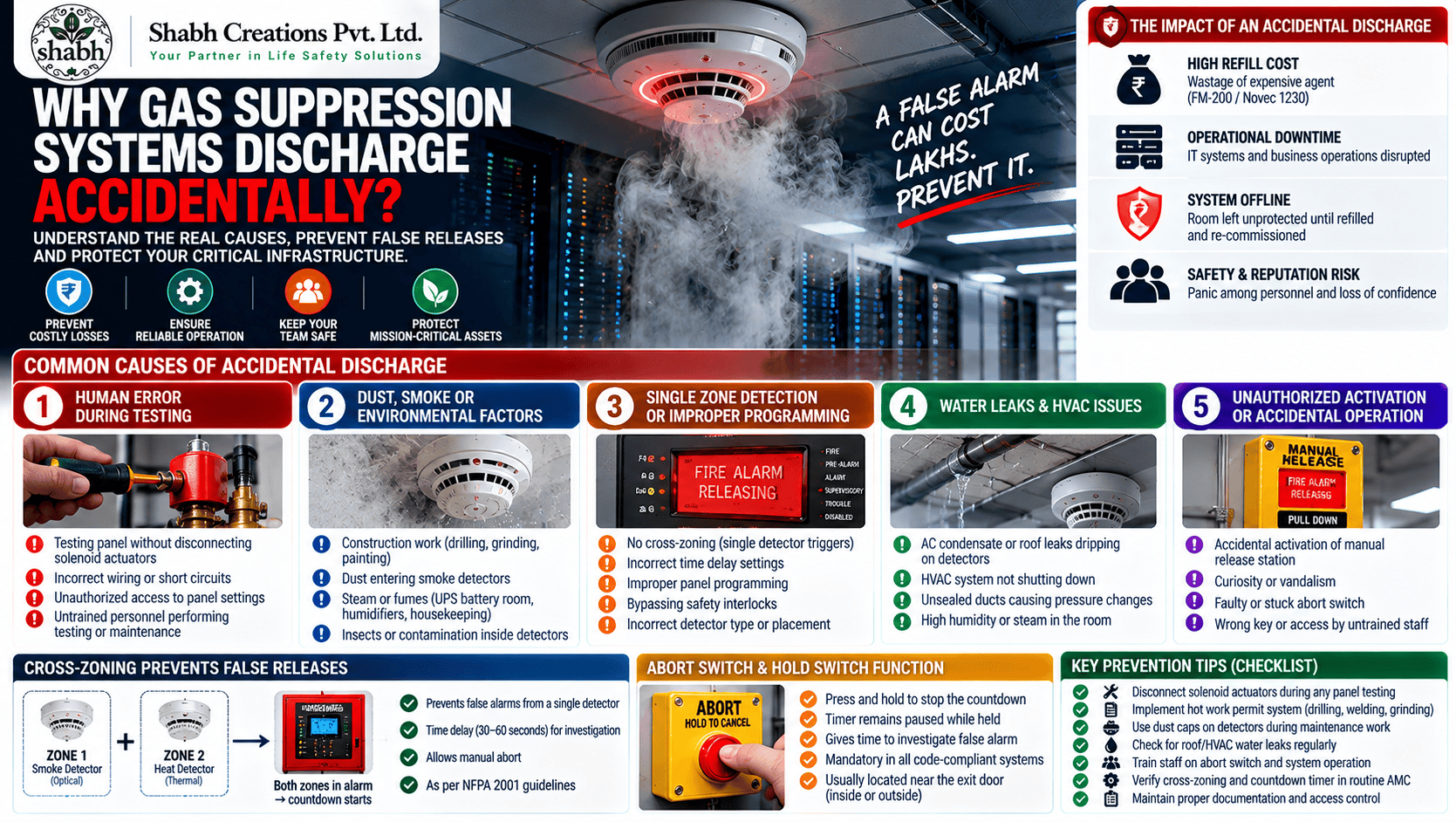
Primary Accidental Clean Agent Discharge Causes
When investigating a false dump, the root cause rarely lies with the extinguishing gas itself; it is almost always linked to human error or environmental interference interacting with the detection network.
One of the most common accidental clean agent discharge causes is untrained maintenance personnel. If a general electrician attempts to test the fire alarm control panel without first physically disconnecting the electrical solenoid actuators from the cylinder valves, the panel will act exactly as programmed and fire the gas.
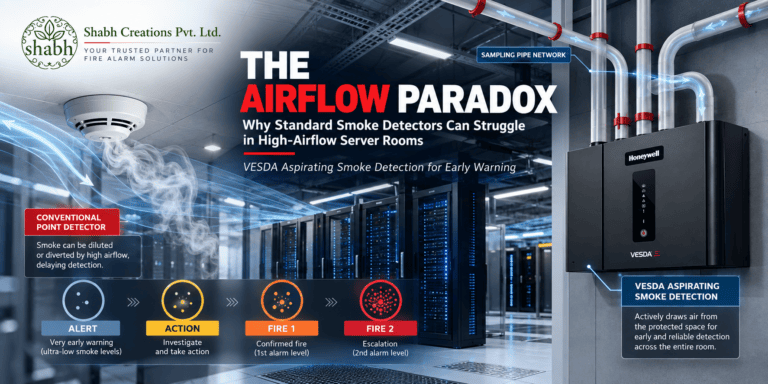
Another leading cause is environmental contamination. If civil contractors are performing drywall repairs or grinding metal inside the server room without placing dust caps over the optical smoke detectors, the heavy dust particles will simulate smoke inside the detector’s chamber, tricking the system into initiating a full discharge sequence.
Engineering Gas Suppression False Release Prevention
Preventing a false dump requires intelligent panel programming. Standard fire alarm panels trigger an alarm immediately when a single detector senses smoke. In a highly sensitive clean agent environment, this single-knock logic is far too risky.
Expert gas suppression false release prevention relies on a programming protocol called cross-zoning (or coincidence logic). Our reliable engineers wire the room’s detectors on two completely independent circuits. The control panel must receive a confirmed alarm signal from both Zone 1 (e.g., an optical smoke detector) and Zone 2 (e.g., a thermal heat detector) before it will start the gas release countdown. If only one detector trips due to dust or a localized steam leak, the panel will merely sound a localized warning buzzer, keeping the expensive gas safely inside the cylinders.
Understanding the Abort Switch and Hold Switch Function
Even with cross-zoning, human oversight remains the ultimate failsafe. This is why every code-compliant clean agent installation features a yellow, highly visible manual intervention button located just inside or outside the primary exit door.
The abort switch and hold switch function is incredibly straightforward but critical. If the control panel enters its 30-second discharge countdown, the warning sirens will activate. If a facility manager investigates and realizes it is a false alarm (e.g., a burnt wire that has already been unplugged), they can press and hold the yellow abort switch. As long as the button is physically held down, the countdown timer is paused, preventing the gas from releasing. This gives the maintenance team time to clear the smoke from the detectors and reset the main control panel.
Gas Suppression System Safety Tips & Checklist
To protect your facility from the massive financial burden of a false discharge, our expert contractors strongly recommend implementing this preventative checklist:
- Mandatory Solenoid Disconnection: Whenever any maintenance is being performed on the fire panel, your trusted supplier must physically unscrew and remove the electrical solenoid actuators from the high-pressure cylinder valves before testing begins.
- Implement a Hot Work Permit System: Before any welding, grinding, or heavy dusting occurs in the server room, the suppression system must be temporarily put into “Manual Only” mode and detectors must be covered with protective dust caps.
- Inspect for Roof Leaks: Water dripping from an AC unit directly into a smoke detector or a junction box can cause an electrical short circuit, which is one of the leading accidental clean agent discharge causes.
- Train Your Staff: Ensure every IT employee and security guard thoroughly understands the abort switch and hold switch function so they can confidently halt a false countdown.
- Verify Cross-Zoning: During your routine Annual Maintenance Contract (AMC), ask your reliable contractor to physically demonstrate that the panel requires two separate detector zones to activate before the timer starts.
Frequently Asked Questions (FAQs)
Can high humidity or steam explain why gas suppression systems discharge accidentally?
Yes. Optical smoke detectors cannot differentiate between heavy smoke, dense construction dust, or thick steam. If an HVAC pipe bursts and fills the room with steam, a poorly programmed system might interpret it as a fire. This highlights why expert gas suppression false release prevention requires cross-zoned logic, adhering strictly to the guidelines of the National Fire Protection Association (NFPA 72 & 2001).
What are the most effective gas suppression system safety tips for a live server room?
The most critical gas suppression system safety tips revolve around isolation. Never allow untrained vendors to open the main suppression control panel. Always ensure your reliable maintenance team places the system in “isolate” or “manual” mode before blowing compressed air into server racks to clean them, as the disturbed dust will instantly trigger the ceiling detectors.
Does using the abort switch completely cancel the fire alarm?
No. The abort switch and hold switch function only pauses the gas release countdown timer while you hold the button down. It does not reset the main fire alarm panel. If you release the button before the main panel is officially reset by a technician, the countdown timer will instantly resume (often with a shortened 10-second penalty timer) as mandated by the Bureau of Indian Standards (BIS).