The Airflow Paradox: Why Standard Smoke Detectors Fail in Modern Server Rooms (And How VESDA Fixes It)
The Airflow Paradox: Why Standard Smoke Detectors Fail in Modern Server Rooms (And How VESDA Fixes It)
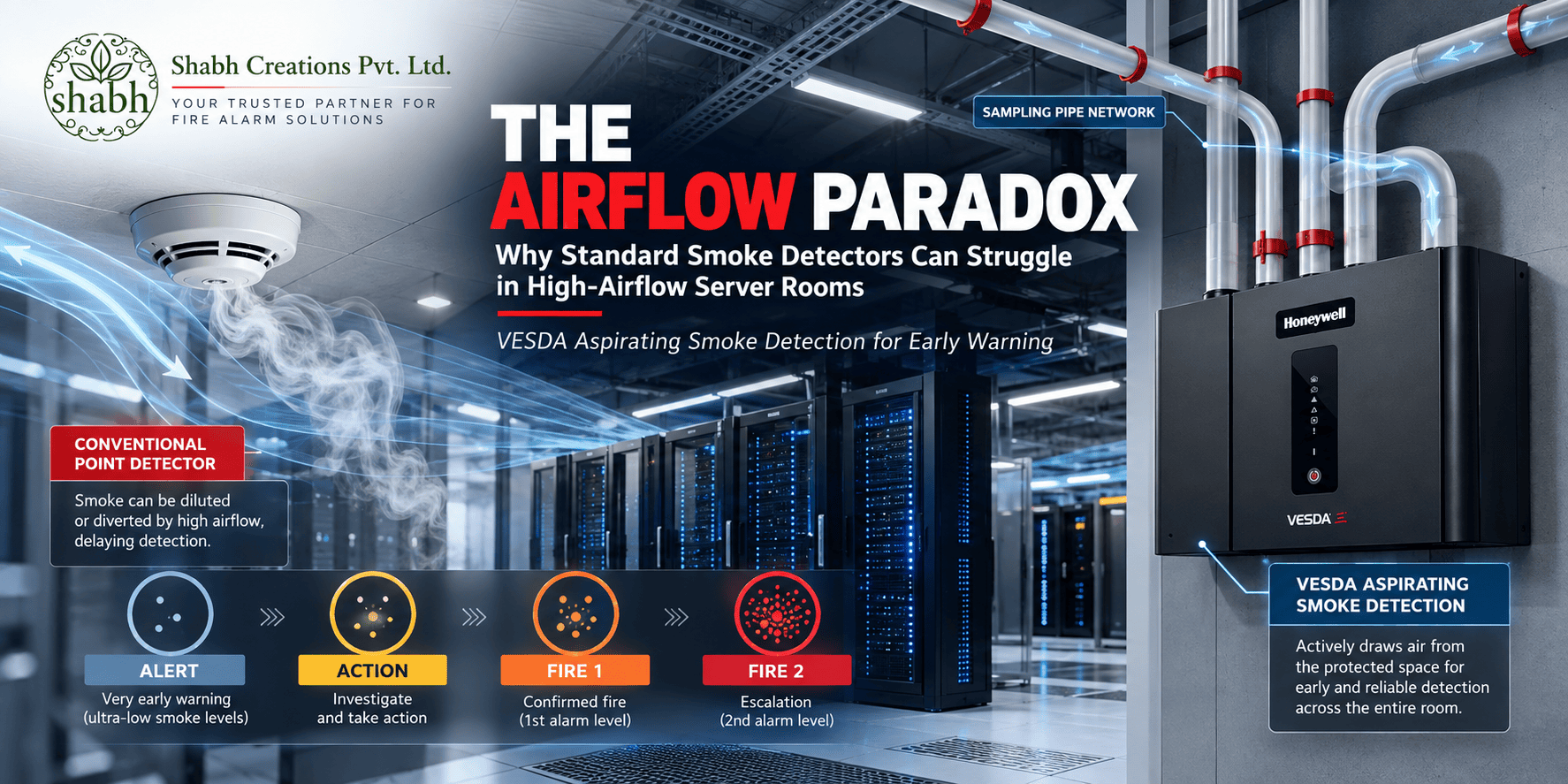
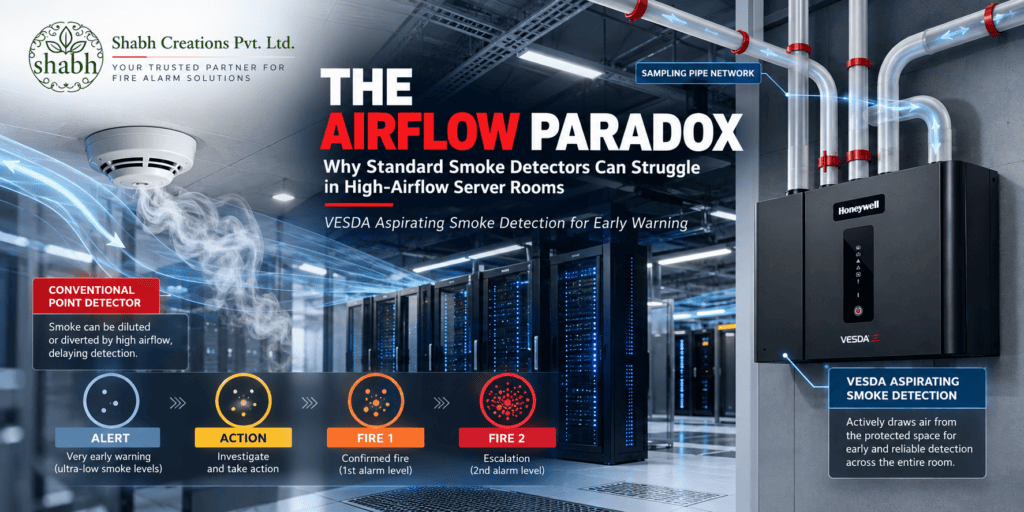
High-velocity cooling systems in modern data centers and IT parks are designed to move massive volumes of air to keep servers cold. However, this same airflow actively pulls early combustion particles away from traditional ceiling-mounted point smoke detectors. By the time a standard optical sensor detects enough smoke to trigger an alarm in a high-airflow environment, cable insulation is likely already melting, and critical hardware is dangerously close to thermal runaway.
While we have previously covered the importance of integrating gas suppression and leak detection in UPS rooms, the initial detection phase in server environments requires a completely different engineering approach: Aspirating Smoke Detection (ASD), commonly known by the industry-leading brand name VESDA.
The Problem with Passive Detection
Standard addressable detectors—even highly calibrated intelligent multi-sensor detectors from brands like Notifier, EST, or Simplex—are passive. They wait for smoke to reach their internal chambers. In a server room, computer room air conditioning (CRAC) units continuously filter and dilute the air, meaning smoke from a smoldering PCB will be dispersed before it ever reaches the ceiling.
This creates a dangerous gap between the actual start of a fire (the incipient stage) and the activation of your gas suppression system, such as an FM-200 or Novec 1230 setup.
How Aspirating Smoke Detection (VESDA) Works
Instead of waiting for smoke to rise, an ASD system actively hunts for it.
- Active Air Sampling: A network of CPVC micro-bore pipes is routed above server racks, across the ceiling, and directly into the return-air paths of the CRAC units.
- Laser-Based Analysis: A centralized detector constantly draws air through these pipes via a built-in aspirator. The air passes through a laser detection chamber that can identify combustion particles before smoke is even visible to the human eye.
- High Sensitivity Smoke Detection (HSSD): These systems are up to 1,000 times more sensitive than conventional point detectors, specifically engineered for cleanrooms and data centers.
The Four-Stage Alert Advantage
The true value of a VESDA system lies in its programmable alarm thresholds, which integrate directly into your primary fire alarm control panel (FACP) via addressable control modules. It provides a staged response rather than a simple binary “on/off” alarm:
- Alert: An early warning that abnormal particulate levels exist. Facilities management can investigate a hot electrical odor without initiating evacuation protocols.
- Action: A higher threshold indicating a developing issue, prompting a targeted response to power down a specific, overheating server rack.
- Fire 1: Triggers the building’s main fire alarm system and alerts the fire department.
- Fire 2: Serves as the critical threshold to activate the server room’s gas suppression system (like Novec 1230).
Engineering the Layout
Installing an ASD system requires precise hydraulic pipe calculations—often modeled using specialized ASPIRE software—to ensure balanced airflow across all sampling holes in the pipe network. If a pipe run is too long or a sampling hole is improperly sized, the system’s transport time will fail NFPA 72 compliance standards.
When upgrading a commercial life safety system or moving from conventional to addressable infrastructure, replacing point detectors with an active air sampling system in high-value asset rooms is one of the most effective risk-mitigation strategies available. The cost of a false gas discharge or hardware loss far outweighs the investment in high-sensitivity detection.
Has your facility recently upgraded its server capacity without re-evaluating the fire detection transport times in your cooling return paths?
What is the “Airflow Paradox” in data center fire detection?
In modern server rooms, high-velocity cooling systems are necessary to maintain temperature, but this rapid airflow actively dilutes and blows early combustion particles away from passive, ceiling-mounted smoke detectors, severely delaying the fire response.
How does Aspirating Smoke Detection (ASD) like VESDA work?
Unlike passive point detectors that wait for smoke to reach them, a VESDA system uses an active aspirator to continuously draw air through a network of micro-bore pipes into a centralized laser detection chamber, identifying combustion particles before smoke is even visible.
Why can’t I just use addressable multi-sensor detectors in a server room?
While highly calibrated addressable detectors from leading commercial brands like Notifier or Simplex are excellent for general open areas, their passive nature makes them too slow for data centers. By the time enough smoke reaches them in a high-airflow environment, critical hardware damage has often already occurred.
How does VESDA integrate with clean agent gas suppression?
VESDA systems provide programmable, multi-stage alerts. A low-level alert allows facility management to investigate, while the highest threshold (Fire 2) can be integrated with the main fire alarm control panel to automatically discharge clean agents like Novec 1230 or FM-200.
What is the NFPA 72 transport time requirement for VESDA?
NFPA 72 compliance requires that the time it takes for an air sample to travel from the furthest sampling hole in the pipe network to the VESDA detector does not exceed specific maximum transport times, which are rigorously tested under standards like UL 268.
Do I need special software to design a VESDA pipe layout?
Yes. Proper installation requires precise hydraulic pipe calculations using specialized software, such as ASPIRE, to ensure balanced airflow across all sampling holes and to guarantee the system’s transport time meets NFPA 72 compliance standards.
What is the difference between Alert, Action, and Fire thresholds in VESDA?
VESDA allows for a staggered response matrix: “Alert” notifies staff of abnormal particles; “Action” suggests targeted power-downs of specific overheating racks; “Fire 1” triggers the building alarm; and “Fire 2” serves as the critical threshold to activate the gas suppression system.
Can VESDA detect a fire before I can smell burning plastic?
Yes. High Sensitivity Smoke Detection (HSSD) systems use laser-based analysis that is up to 1,000 times more sensitive than conventional detectors, identifying the incipient smoldering of PCB boards or wire insulation long before human senses can detect it.
Is upgrading to VESDA worth the cost for an existing server room?
Absolutely. The cost of a single false gas discharge or the permanent loss of high-value hardware and data due to delayed detection far outweighs the initial investment of retrofitting an active air sampling system into your cooling return paths.