
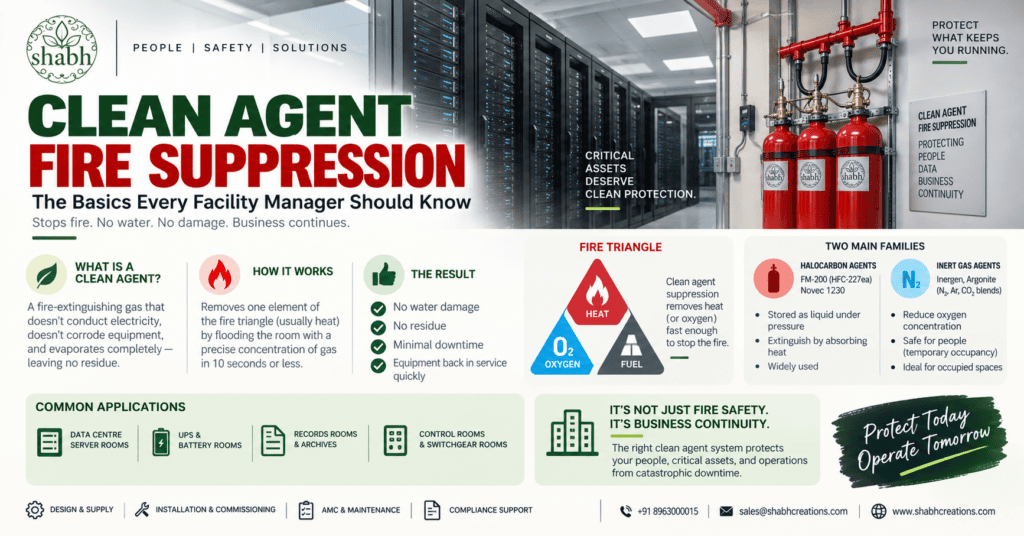
Expert Clean Agent Fire Suppression System: The Basics Every Facility Manager Should Know
Shabh Creations Pvt. Ltd. provides turnkey design, installation, refilling, and Annual Maintenance Contracts (AMC) for clean agent fire suppression systems across Delhi NCR and India. We engineer FM-200, Novec 1230, and Inert Gas systems strictly compliant with NFPA 2001 and IS 15493 standards to protect critical server rooms, data centers, and UPS battery banks.
If your facility houses a server room, a UPS/battery bank, or an archive of records that can’t be replaced, a sprinkler head going off is sometimes almost as damaging as the fire it’s fighting. That’s the exact problem clean agent fire suppression system is designed to solve.
What is a “clean agent”? ( In clean agent fire suppression )
A clean agent is a fire-extinguishing gas that doesn’t conduct electricity, doesn’t corrode equipment, and evaporates completely — leaving no residue and no water damage behind. Because the agent evaporates without a trace, equipment can typically go back into service with little to no cleanup once the space is ventilated. In the US, these systems are governed by NFPA 2001, the Standard on Clean Agent Fire Extinguishing Systems; in India, the equivalent reference point is IS 15493.
How fire suppression system actually works?
Every fire needs three things: heat, oxygen, and fuel. This is often called the fire triangle. Clean agent systems are engineered to knock out one leg of that triangle — most commonly heat — fast enough to stop combustion before it spreads.
The system floods the entire protected room evenly to a precise, pre-calculated concentration, a method called total flooding. This lets the agent reach a fire hidden behind server racks or inside equipment enclosures that a point-source extinguisher would miss entirely. Discharge typically happens in 10 seconds or less, well before a conventional sprinkler system would even activate.
The two main families of clean agent fire suppression system
Halocarbon agents based fire suppression system—
FM-200 (also called HFC-227ea) and (FK-5-1-12, 3M™ Novec™) are the most widely used. Both are stored as a liquid under pressure and discharge as a gas. They extinguish by absorbing heat rapidly, interrupting the chemical chain reaction that sustains the flame.
Inert gas agents based fire suppression system —
blends of nitrogen, argon, and sometimes CO2 (marketed under names like Inergen or Argonite). Instead of absorbing heat, these work by reducing the oxygen concentration in the room to a level that can no longer support combustion, while staying within limits safe for people to breathe temporarily.
Neither family should be read as “the old option” versus “the new option” — the right choice comes down to the room’s size, cylinder storage space available, occupancy, and total cost of ownership, not which agent is newer to market.
Where these clean agent fire suppression system get specified
Clean agent fire suppression system shows up most often in:
- Data centre server halls and network equipment rooms
- UPS and battery rooms
- Records rooms, archives, and museums
- Control rooms and switchgear rooms where water or foam would take down critical assets along with the fire
Go to Clean Agent Flooding System AMC & SITC Services Page
Why this matters for compliance decision-makers
For a data centre or hospital, the suppression method isn’t just a fire-safety line item — it’s a business-continuity decision. A water-based system that trips accidentally can cause more downtime and equipment loss than a small, contained fire would have. Getting the system design, agent selection, and concentration calculations right at the design stage avoids both under-protection and expensive over-engineering.
This article is provided by Shabh Creations Pvt. Ltd. for general awareness of fire and life safety practices. It is not a substitute for a site-specific fire safety assessment or design certified by a qualified professional. For AMC, design, or compliance support tailored to your facility, reach out to us at sales@shabhcreations.com.
Our Clean Agent Suppression Services
- System Design & Hydraulic Flow Calculations: Ensuring exact agent concentration.
- Cylinder Refilling & Hydrotesting: Fast turnaround for discharged FM-200 and Novec 1230 cylinders.
- Room Integrity Testing (Door Fan Test): Mandatory testing to ensure the room can hold the gas for the required 10-minute retention time.
- Comprehensive AMC: Annual inspections of detection
Frequently Asked Questions
Which agent should we choose — FM-200, Novec 1230, or an inert gas blend?
It depends on room size, available space for cylinder storage, environmental considerations, and budget — there’s no universal “best” choice. This is exactly the kind of decision that should go through a proper hazard and space calculation before you commit, not a generic recommendation.
What happens after the system discharges — does the room need to be evacuated for hours?
No. Because the agent leaves no residue and isn’t corrosive, the room can usually be re-entered and returned to service once it’s ventilated and re-charged with a fresh cylinder — often within the same day, not days.
How often does a clean agent system need to be inspected?
According to IS 15493 and local fire norms, cylinders require continuous weight/pressure monitoring, with comprehensive physical inspections of the discharge nozzles and detection panel conducted bi-annually or annually. Shabh Creations provides bundled AMC packages to handle this compliance for facilities across India.
Is clean agent gas safe for people if it discharges while someone is in the room?
Yes, when the system is designed and installed to NFPA 2001 / IS 15493 concentration limits for the specific agent. Rooms are calculated to use enough agent to suppress the fire while staying within safe human exposure levels for the discharge duration. That said, standard practice is still to evacuate immediately on alarm — the system is a backstop, not a reason to linger.
How is a clean agent system different from a standard fire alarm?
A fire alarm only detects and signals. A clean agent system is a full suppression system — it detects, then automatically releases the extinguishing gas into the room. The two are usually integrated: the detection panel triggers the discharge.
Does a clean agent system replace the need for sprinklers?
Not usually — most facilities run clean agent suppression in the critical room (server hall, UPS room) as the primary protection, with the building’s standard sprinkler system still covering the space as required by code. Check with your fire consultant on whether local regulation allows clean agent as a sole system for your occupancy class.