Fire Rated Steel Door Ratings Explained:
Fire Rated Steel Door Ratings Explained: IS 3614 and NFPA/UL Standards Compared
A technical guide for facility managers, architects, and compliance teams specifying fire doors for commercial and industrial buildings in India.
At Shabh Creations, we provide end-to-end supply, installation, and AMC compliance for certified fire-rated steel doors across commercial and industrial facilities in India.
A fire-rated door isn’t just a heavy steel slab — it’s a certified life-safety assembly. The leaf, frame, hinges, seals, glazing, and hardware are tested together as one system, and the rating only holds if every component matches what was certified. Swap out one uncertified part, and the door’s actual fire resistance can fall far short of its labelled rating, regardless of how solid it looks.
The fire rated steel door rating scale: what the numbers mean
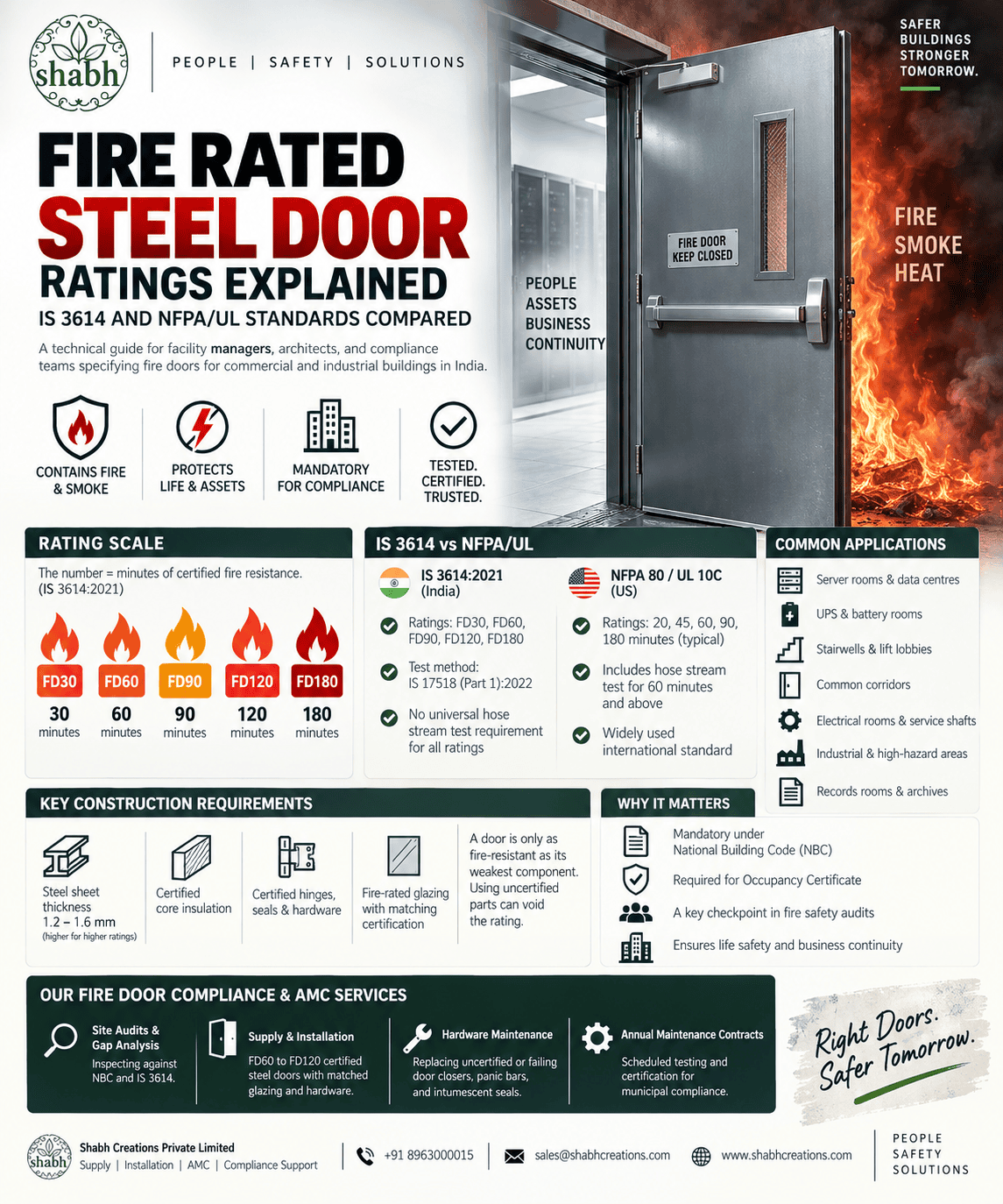
A fire door’s rating is the number of minutes it’s certified to hold back fire and smoke under standardised furnace testing. In India, this is governed by IS 3614:2021, which defines five standard ratings — FD30, FD60, FD90, FD120, and FD180 — corresponding to 30, 60, 90, 120, and 180 minutes of certified fire resistance. Furnace testing itself now follows IS 17518 (Part 1):2022, the dedicated Indian test method for fire-resistant door and shutter assemblies.
Internationally, NFPA 80 (which references UL 10C) uses a broadly similar minute/hour scale, though door assemblies rated 60 minutes or higher must additionally pass a hose stream test immediately after fire exposure — a structural-integrity check for how the assembly holds up under sudden thermal shock and water pressure, simulating firefighting conditions. IS 3614 does not mandate this hose stream test universally across all ratings, which is one of the meaningful differences between the two frameworks.
What each rating is typically used for
- FD30 (30 minutes): The baseline rating for low-hazard internal compartmentation — flat-entrance doors onto a protected corridor, light internal partitions, and service shaft access in residential and light-commercial settings.
- FD60 (60 minutes): The most commonly specified rating in Indian construction. Used for stairwell and lift-lobby doors, basement-to-core access, and common corridor doors in mid-rise commercial and residential buildings — giving occupants and emergency responders a full hour for evacuation and response.
- FD90 (90 minutes): Required for higher-hazard separations — electrical rooms, server rooms, data centres, building service shafts, and horizontal exits in high-occupancy or institutional buildings.
- FD120 and FD180 (120–180 minutes): Reserved for major occupancy separations and fire walls in industrial and critical-infrastructure settings — heavy factories, petrochemical facilities, and high-hazard storage. Steel remains the practical choice at this tier, since few timber or composite alternatives are certified for ratings this high.
Construction requirements that determine the rating
IS 3614:2021 ties minimum steel sheet thickness for metallic door frames to the rating being certified — generally in the range of 1.2 mm to 1.6 mm, with heavier gauges required at higher ratings. Core insulation material, seal type, and hinge and hardware specification are all part of the same certified assembly; substituting any of these components without re-testing voids the rating.
Where vision glass panels are specified, the glazing, frame, gasket, and any hardware (including panic bars) must independently meet fire-rated standards matching the door’s overall rating. A door is only as fire-resistant as its weakest certified component — an uncertified glass panel or door closer can undermine an otherwise correctly specified FD90 or FD120 door.
Why this matters for compliance and audits
Under the National Building Code (NBC), fire doors are a mandatory passive fire protection measure, and municipal authorities will not issue an Occupancy Certificate without compliant, certified fire door installations. For facility managers running commercial, industrial, or data centre sites, ensuring the correct door rating, steel gauge, and component certification against local building codes is now a standard checkpoint in any serious fire safety audit — not a formality.
Our Fire Door Compliance & AMC Services
- Site Audits & Gap Analysis: Inspecting existing door assemblies against NBC and IS 3614 requirements.
- Supply & Installation: Sourcing FD60 to FD120 certified steel doors with matched glazing and hardware.
- Hardware Maintenance: Replacing uncertified or failing door closers, panic bars, and intumescent seals.
- Annual Maintenance Contracts (AMC): Scheduled testing and certification for municipal compliance.
Official references: IS 3614:2021 and IS 17518 (Part 1):2022 (Bureau of Indian Standards); NFPA 80 and UL 10C (US); National Building Code of India.
This article is published by Shabh Creations Private Limited for general informational purposes and reflects publicly available standards as of September 2026. It does not constitute site-specific fire safety or engineering advice. Facility-specific door specifications should be verified against the applicable local building code and confirmed with a qualified fire safety engineer.
For a fire door compliance audit or AMC support for your facility, contact Shabh Creations at sales@shabhcreations.com, +91 8963000015, or www.shabhcreations.com.
FREQUENTLY ASKED QUESTIONS (FAQ)
How often must fire-rated doors be inspected in India?
According to the National Building Code (NBC) and local municipal fire safety regulations, commercial fire-rated doors must be inspected at least annually. Regular inspections ensure that the intumescent seals, door closers, and panic hardware are functioning correctly. Shabh Creations provides comprehensive Annual Maintenance Contracts (AMC) to keep your facility’s passive fire protection compliant and audit-ready.
Can I replace a fire door handle with standard hardware?
No. Fire-rated steel doors are tested and certified as a complete assembly under IS 3614. Replacing a certified door closer, panic bar, or hinge with standard uncertified hardware immediately voids the door’s fire rating. Our certified technicians supply and install only matched, fire-rated hardware to maintain your building’s structural fire resistance.