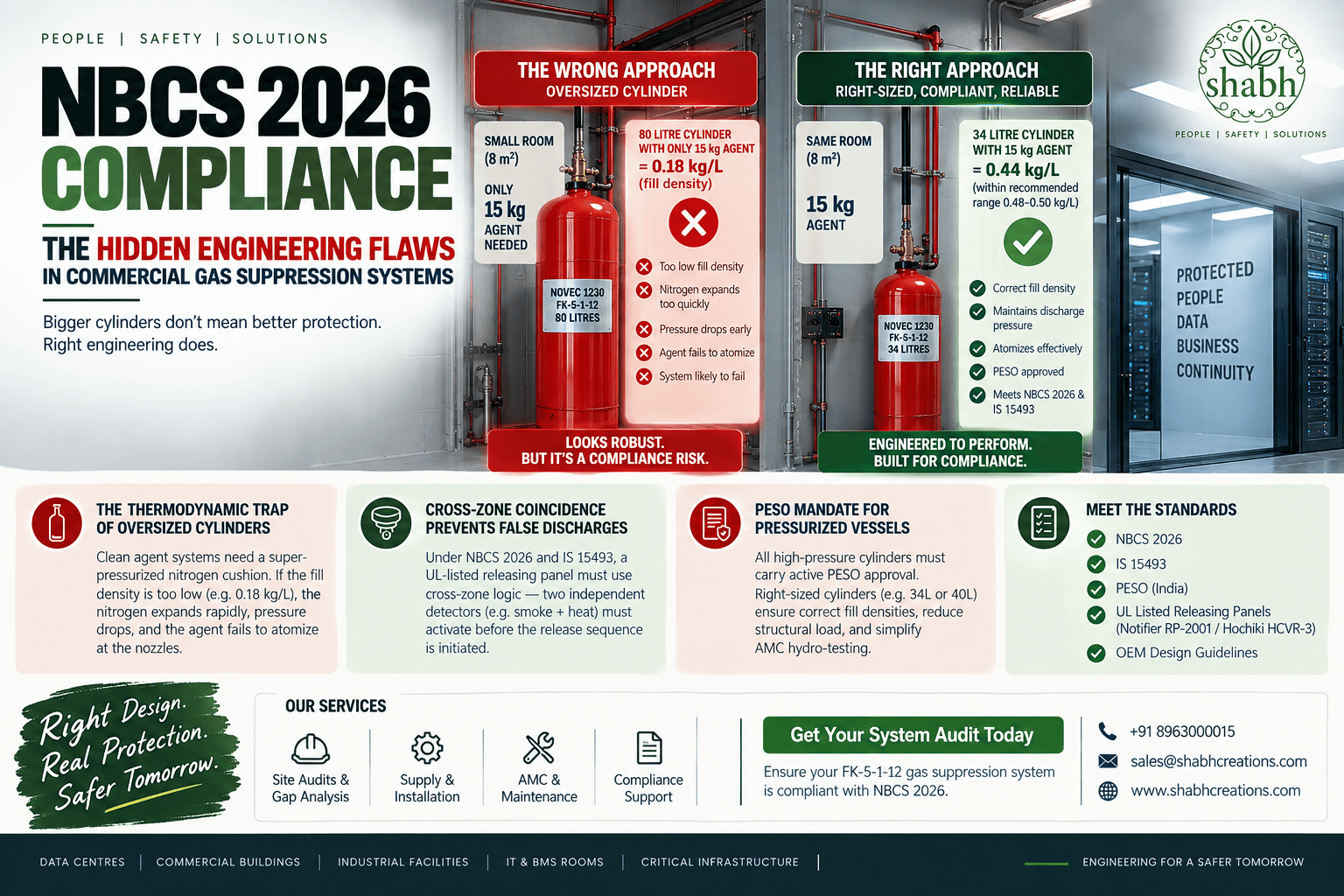
NBCS 2026 Compliance: The Hidden Engineering Flaws in Commercial Gas Suppression Systems
Bigger cylinders don’t necessarily mean better protection. Correct cylinder sizing, fill density, piping design, detection logic and compliant equipment are critical to a reliable clean-agent fire suppression system.
Shabh Creations helps businesses with gas suppression systems for server rooms, data centres, UPS rooms, BMS rooms, electrical rooms and other critical facilities — from design and installation to commissioning, AMC and compliance support.
Need a system audit or new gas suppression system?
Visit Shabh Creations for engineering and fire-safety solutions.
NBCS 2026 Compliance: The Hidden Engineering Flaws in Commercial Fire Suppression Systems
India’s transition to the National Building Code for Safety (NBCS) 2026 has fundamentally shifted how corporate facilities must approach their annual fire safety audits. It is no longer enough to simply have pressurized red cylinders sitting in the corner of an IT or BMS room. Facility managers and auditors are now rigorously scrutinizing the hydraulic engineering and detection logic behind these installations to ensure they actually perform under emergency conditions.
At Shabh Creations, our recent audits of commercial clean agent systems (such as FK-5-1-12) have uncovered a persistent, critical flaw in legacy installations: systems that are artificially over-engineered to the point of mechanical failure.
The Thermodynamic Trap of Oversized Cylinders
One of the most frequent compliance failures we see in corporate server rooms is the improper sizing of clean agent cylinders. To simplify procurement or overcome remote storage distances, contractors frequently install massive 80-liter or 180-liter cylinders to protect small 8-square-meter communication rooms.
While this looks robust on a BOQ, it violates fundamental fluid dynamics. Clean agent systems require a super-pressurized cushion of dry nitrogen to propel the liquid agent through the piping network within the mandated 10-second discharge window. To maintain this pressure, the cylinder must meet a strict minimum fill density (typically 0.48 to 0.50 kg/L).
When 15 kg of agent is dumped into an 80-liter cylinder, the fill density drops to a dangerous 0.18 kg/L. If that system actuates, the nitrogen expands too rapidly, the kinetic pressure drops prematurely, and the agent fails to atomize at the nozzles. Facilities are relying on systems mathematically destined to fail.
Cross-Zone Coincidence: Ending False Discharges
Under the stringent guidelines of NBCS 2026 and IS 15493, the prevention of accidental discharges is treated with the same severity as the suppression itself. An accidental gas dump not only leaves critical infrastructure unprotected but costs facilities lakhs of rupees in emergency refill expenses and operational downtime.
Standardizing release mechanisms is critical. A compliant gas suppression system also known as fire suppression system must utilize a UL-Listed dedicated releasing panel (such as the Notifier RP-2001 or Hochiki HCVR-3) explicitly programmed for cross-zone coincidence detection. This logic mandates that two independent sensors (e.g., one photoelectric smoke detector and one heat detector) must trigger simultaneously before the release sequence is initiated.
The PESO Mandate for Pressurized Vessels of fire suppression system
Statutory compliance extends beyond the electronic panel. Any high-pressure suppression hardware installed in a commercial facility must carry active approval from the Petroleum and Explosives Safety Organisation (PESO). Replacing unnecessarily massive 180L cylinders with right-sized 34L or 40L PESO-approved containers not only ensures correct hydraulic fill densities but also resolves structural floor-loading issues in raised-floor data centers and simplifies AMC hydro-testing logistics.
Securing Your Infrastructure
As NBCS 2026 enforcement tightens, facilities can no longer afford to rely on basic visual inspections for their gas suppression system networks. Ensuring that your FK-5-1-12 systems are hydraulically balanced, legally filled, and electronically secured against false alarms requires specialized engineering oversight.
To verify if your server room’s fire suppression system meets these updated 2026 standards, contact the engineering team at Shabh Creations to schedule a comprehensive hydraulic and electronic audit.
Our Pre-Design Engineering Methodology: How We Ensure a Flawless System
Engineering a clean agent gas suppression system requires absolute precision. A failure during discharge is almost always rooted in oversights made before the first pipe is drawn. Here is the structured engineering process we follow—and the critical parameters we verify—before finalizing any design.
Phase 1: Pre-Design Site & Architectural Assessment
- True Volumetric Survey (Beyond Carpet Area)
- We do not calculate agent mass based on room floor area alone. We measure the exact slab-to-slab height, incorporating both the drop-ceiling void (above false ceiling) and the sub-floor void (under raised access floors).
- If these voids are not physically sealed or protected, clean agent will dilute into them, causing concentration failure.
- Enclosure Integrity & Room Leakage Analysis
- Clean agent systems rely on maintaining design concentration for a minimum 10-minute “hold time” to prevent reignition.
- We inspect all cable trays, pipe penetrations, unsealed perimeter joints, and doors to specify firestopping and door weather-stripping prior to commissioning the mandatory Door Fan / Room Integrity Test.
- Cylinder Placement vs. Hydraulic Route
- We evaluate whether cylinders can be housed locally inside the hazard zone or must be placed in remote service corridors due to site constraints (such as server rack clearance or architectural access restrictions).
- If remote placement is mandatory, we establish the maximum equivalent pipe run to decide between a standard 25-bar system and an upgraded 42-bar network.
Phase 2: Thermodynamic & Hydraulic Modeling
- Agent Quantity & Minimum Fill Density Verification
- We calculate the net agent weight required based on the design concentration (e.g., 4.7% to 5.6% for FK-5-1-12 under IS 15493 / NFPA 2001) adjusted for minimum ambient site temperatures and altitude.
- We cross-check the required agent weight against container volumes to ensure the fill density strictly stays within OEM operating limits (0.48 kg/L to 1.12 kg/L), completely avoiding under-filled cylinders and premature nitrogen pressure loss.
- Software-Aided Hydraulic Balancing (10-Second Discharge Rule)
- We model the piping isometrics through certified flow-calculation software.
- We calculate pipe diameter sizing, tee-split ratios, elevation head loss, and nozzle orifice sizes to guarantee uniform gas distribution and confirm the agent fully discharges within the mandatory 10-second window.
- Overpressure & Underpressure Relief Venting (PRV)
- When clean agent discharges within 10 seconds, it displaces air and causes rapid, temporary pressure swings (peak positive pressure during liquid expansion followed by negative thermal shock).
- We calculate the required free vent area ($A_v$) and specify calibrated pressure relief dampers (PRVs) on external walls to prevent structural damage to false ceilings, viewing glass, or drywall partitions.
Phase 3: Electrical, Detection & Building Interlocks
- Cross-Zone Coincidence Detection Architecture
- To completely prevent costly accidental discharges, we configure the detection network with dual-detector coincidence logic.
- Zone 1 (typically an optical smoke detector) issues a pre-alarm and alerts site security; Zone 2 (a heat or multi-sensor detector) confirms the thermal event and initiates the 30-second discharge countdown.
- HVAC & Damper Trip Interlocks
- A clean agent cannot extinguish a fire if the HVAC system continues exhausting air or pumping fresh oxygen into the space.
- We design electrical trip interlocks so that upon 1st or 2nd stage alarm:
- Dedicated Precision Air Conditioning (PAC) units or Air Handling Units (AHUs) automatically shut down.
- Motorized Fire & Smoke Dampers (MFSD) on supply and return air ducts snap shut automatically before gas discharge.
Phase 4: Statutory Compliance & Equipment Approvals
- PESO Vessel Certification
- We ensure every seamless or welded pressurized cylinder specified carries valid approval and stamping from the Petroleum and Explosives Safety Organisation (PESO) under Indian Gas Cylinders Rules.
- Regulatory Harmonization
- All calculation sheets, equipment schedules, and sequence-of-operations (SOO) are aligned to NBCS 2026 (Part 4), IS 15493, and NFPA 2001 standards, ensuring rapid approvals during third-party safety audits and seamless fire NOC compliance.
Frequently Asked Questions (FAQs)
What is the required discharge time for an FK-5-1-12 gas suppression system?
Under IS 15493 and NFPA 2001, the entire calculated mass of FK-5-1-12 must discharge through the distribution network and achieve design concentration within a maximum of 10 seconds. Exceeding this window allows thermal decomposition of the agent and increases combustion damage.
How does NBCS 2026 affect existing clean agent installations?
Existing installations must undergo periodic inspection and maintenance audits that verify hydraulic calculations, cylinder pressure retention, and panel interface relays. Systems showing severe under-fill ratios, unverified piping modifications, or missing coincidence interlocks must be re-engineered to meet current life-safety and operational standards.
Are standard industrial gas cylinders acceptable for clean agent systems in India?
No. All seamless or welded pressurized cylinders deployed for gaseous fire suppression must hold explicit approval from the Petroleum and Explosives Safety Organisation (PESO) under the Gas Cylinders Rules. Using non-approved vessels or unverified imports invalidates building fire NOCs and fails statutory third-party safety audits.
Why is cross-zone detection required instead of single-detector activation?
Single-detector activation carries a high risk of false trips caused by dust, humidity swings, or minor electrical maintenance work. Cross-zone coincidence detection requires two separate detectors on distinct initiating circuits (such as an optical smoke detector and a rate-of-rise heat detector) to confirm an event before initiating the 30-second discharge countdown, eliminating costly accidental gas dumps.
What is the minimum fill density for FK-5-1-12 cylinders, and why does it matter in fire suppression system?
Original Equipment Manufacturers (OEMs) typically mandate a minimum fill density between 0.48 kg/L and 0.50 kg/L. Maintaining this threshold ensures an adequate ratio of liquid agent to pressurized nitrogen. If a cylinder is under-filled, the nitrogen cushion expands prematurely upon discharge, dropping the kinetic pressure too fast and preventing the clean agent from properly atomizing into a fire-suppressing vapor.