NBCS 2026 Has Replaced NBC 2016. Here’s What Actually Changes for Fire Safety in NCR.
If you manage fire safety compliance for a commercial or industrial facility in Delhi NCR, you’ve probably heard some version of “the building code changed” over the past few months. Most of what’s circulating online is either too technical for a facility manager to act on, or vague enough to be useless. Here’s what actually happened, what it means for your Fire NOC and AMC documentation today, and what to watch for over the next year.
NBCS 2026 Fire Safety Changes: What Happened.
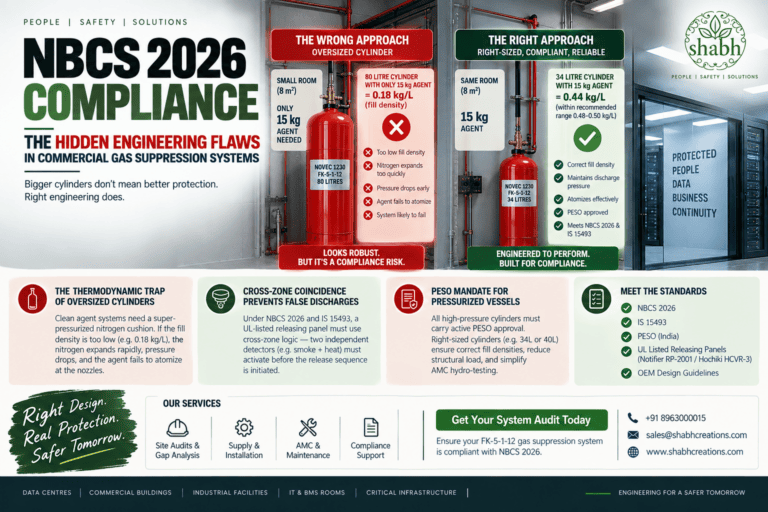
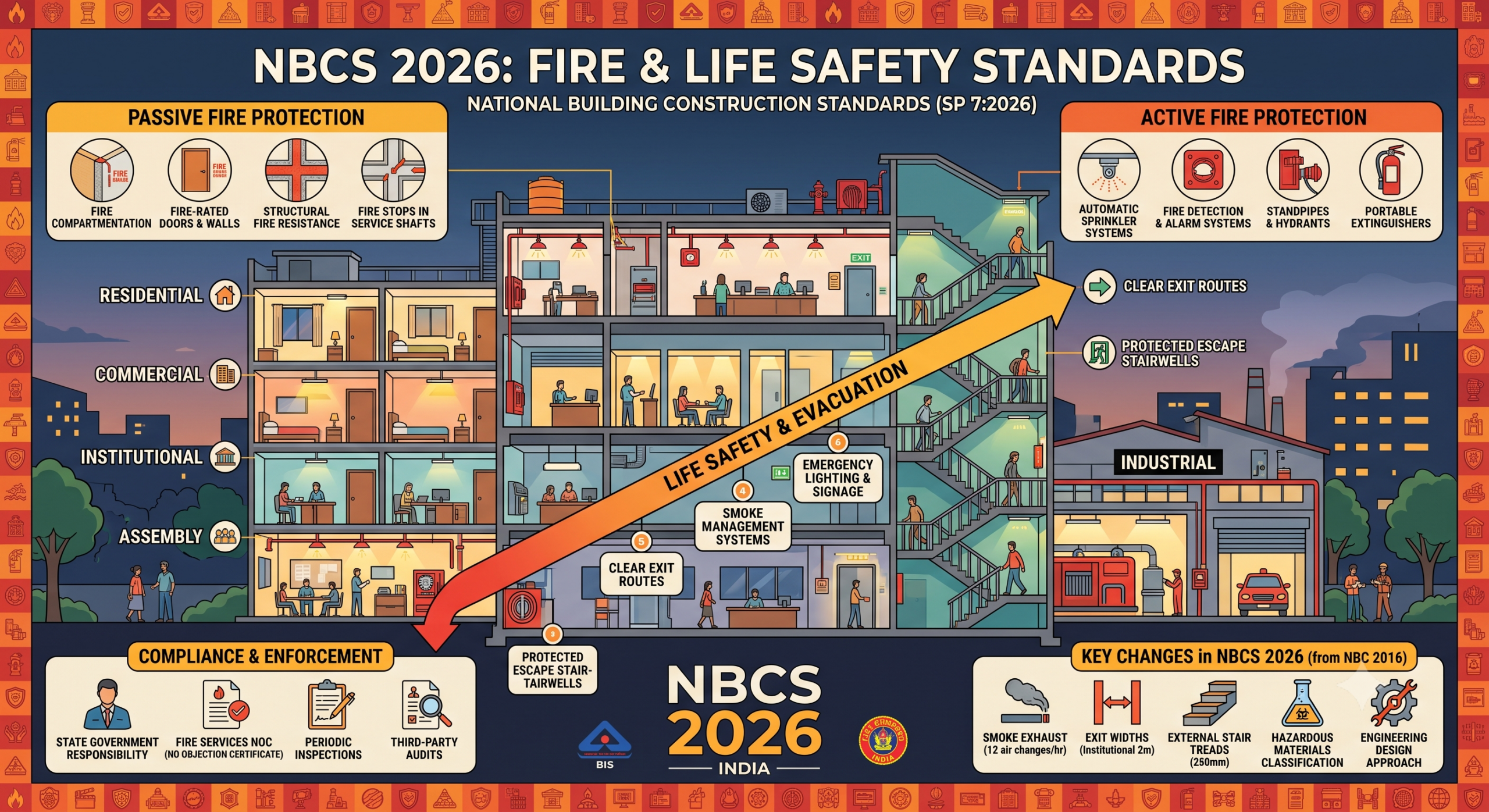
On 30 April 2026, the Bureau of Indian Standards formally withdrew the National Building Code 2016 and replaced it with the National Building Construction Standards 2026 (NBCS 2026, designated SP 7:2026). It’s the first major overhaul of India’s building standards framework in over a decade, and the fire and life safety provisions — now consolidated into Part F — include some of the most discussed changes in the entire document.
Three changes matter most if you’re responsible for a facility’s fire safety compliance:
1. The high-rise threshold moved from 15 metres to 24 metres. Under the old code, any building 15m or taller was classified as high-rise and subject to enhanced fire safety requirements. Under NBCS 2026, that threshold rises to 24m — meaning a typical 5-to-8 storey commercial or residential building would no longer automatically fall into the high-rise category.
2. The language shifted from mandatory to advisory. NBC 2016 used prescriptive “shall” requirements — exact materials, exact dimensions, one compliant answer. NBCS 2026 uses performance-based “should” language: it specifies the safety outcome required (e.g., a 2-hour fire resistance rating) and allows any tested system that achieves it. This opens the door to newer construction methods and materials that previously had no clear approval path.
3. Overall building height restrictions were removed entirely at the national standard level, with height now governed purely by local byelaws and aviation/defence restrictions.
What This Does NOT Mean — Yet
This is the part most coverage skips, and it’s the part that actually matters for your Fire NOC.
NBCS 2026 fire safety is voluntary at the national level. It only becomes legally enforceable once your state government adopts its provisions into local building byelaws — and fire services are constitutionally a state subject, not a central one. Until Uttar Pradesh, Haryana, or Delhi formally update their byelaws, the fire safety requirements your facility is actually held to are still whatever your state currently references — in most cases, that’s still effectively NBC 2016 as it was adopted locally.
Historical precedent for this kind of transition runs 12 to 24 months from national notification to state adoption. As of the most recent public tracking, no state had yet formally adopted NBCS 2026 into its byelaws. Progressive states with active building standards committees are expected to move first — but which of the NCR jurisdictions moves early, and on what timeline, isn’t settled yet.
Practically, this means:
- Your Fire NOC renewal criteria haven’t changed yet — they’re set by your state fire department, not directly by BIS
- Don’t assume a building between 15m and 24m is automatically exempt from high-rise fire safety requirements until your local authority confirms it’s adopted the new threshold
- Existing AMC documentation, audit reports, and compliance filings should continue referencing the standards your state currently enforces
- If you’re in early design or planning for a new facility, it may be worth designing with NBCS 2026’s (NBCS 2026 fire safety) performance-based provisions in mind, but confirm acceptance with your local building authority before relying on it for approval
Why It’s Still Worth Paying Attention Now
Even in the transition gap, three things are worth doing:
- Watch for circulars from your state’s urban development or municipal authority. This is where an actual byelaw change will first appear — not in a BIS notification, and not in a general news article.
- If your facility sits close to the old 15m high-rise line, it’s worth knowing which side of the new 24m threshold you’d fall on once (and if) your state adopts it — this affects what enhanced fire safety systems you’d eventually need or could eventually simplify.
- Keep your AMC and audit trail clean regardless. Whichever standard ends up governing your Fire NOC — old or new — documented, dated maintenance records are what actually get you through an audit. That part doesn’t change. (NBCS 2026 fire safety)
Frequently Asked Questions
Is NBCS 2026 mandatory right now?
No. It’s published as a voluntary standard by BIS. It becomes enforceable only once your state adopts it into building byelaws, which typically takes 12–24 months from national notification.
Does this affect my Fire NOC renewal today?
Not directly. Fire NOC criteria are set by your state fire department. Until your state updates its byelaws to reference NBCS 2026, existing criteria continue to apply.
My building is 18 metres tall — am I still classified as high-rise?
Under the previous standard, yes. Under NBCS 2026’s new 24m threshold, you wouldn’t be — but only once your state formally adopts that threshold. Until then, the existing classification holds.
What should I actually do about this right now?
Nothing drastic. Keep your current AMC and compliance documentation up to date, and treat any NBCS 2026-related change to your Fire NOC requirements as something your fire safety provider should be tracking on your behalf, not something you need to act on unilaterally.
Sources:Bureau of Indian Standards gazette notification (30 April 2026), bis.gov.in. Full text of SP 7:2026 is accessible through BIS’s standards portal with a free account — there is no single public URL for the complete document, and third-party “free PDF” downloads circulating online are frequently outdated or mislabeled editions. This article reflects publicly available information as of the standard’s transition period and does not constitute legal or regulatory advice — confirm current Fire NOC requirements with your local fire department.