Expert Guide: Rodent Damage to Cables – A Hidden Server Room Fire Risk
Rodents damaging server room cables
Modern data centers are designed like digital fortresses. Facility managers invest heavily in biometric access controls, redundant power grids, and advanced clean agent fire suppression systems. However, one of the most destructive threats to your mission-critical infrastructure can easily slip under a door sweep: rodents. A single rat inside a server room can cause catastrophic electrical failures, massive data loss, and severe thermal events.
As a trusted life safety expert, Shabh Creations Pvt. Ltd. frequently diagnoses and engineers solutions for complex facility hazards. In this comprehensive guide, we explore the severe rodent fire risk in data centers, why these pests target IT environments, and the engineering strategies required to protect your facility.
The Threat of Rodents Damaging Server Room Cables
To understand the threat, we must first understand rodent biology. Rats and mice possess incisor teeth that grow continuously throughout their lives. To keep these teeth trimmed, they must constantly gnaw on hard materials.
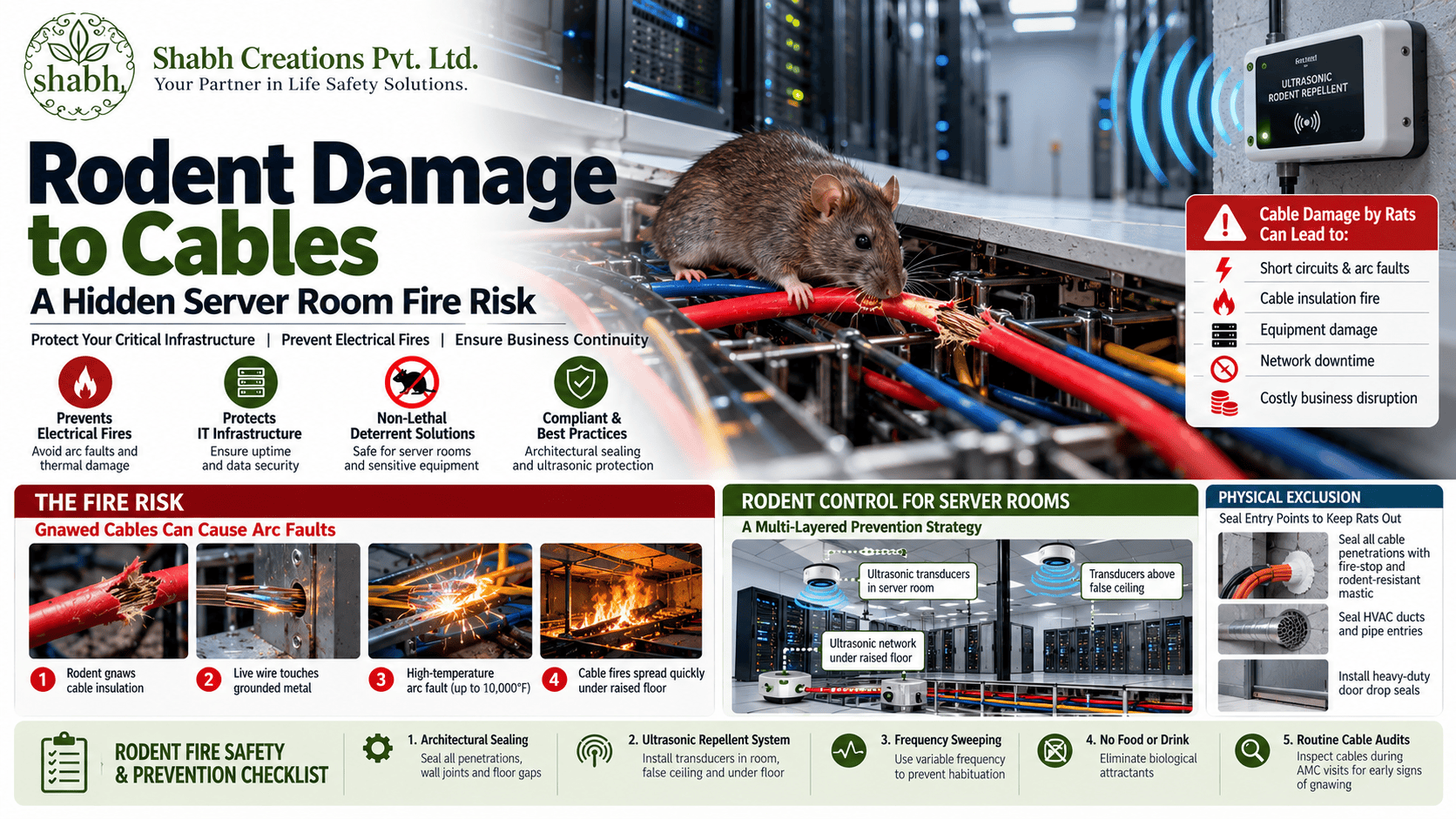
Unfortunately, the soft polymer insulation surrounding high-voltage power lines and delicate fiber optic cables provides the perfect chewing resistance. The reality of rodents damaging server room cables is incredibly common. When a pest chews through the outer insulation of a power cable, it exposes the live copper wire beneath. If that exposed wire touches the grounded metal of a raised floor pedestal or a cable tray, it instantly creates a high-energy arc fault.
Understanding the Cable Damage by Rats Fire Hazard
An arc fault is not a simple short circuit that immediately trips a breaker. It is a sustained, superheated electrical discharge that can easily reach temperatures exceeding 10,000°F.
This phenomenon creates an extreme cable damage by rats fire hazard. The intense heat from the arc fault instantly ignites the surrounding cable insulation, plastic conduits, and accumulated dust. Because this typically occurs under the raised IT floor or above a suspended false ceiling, the fire can spread rapidly across the cable network completely undetected by standard ceiling-mounted smoke detectors until it is too late.
Specialized Rodent Control for Electrical Rooms
Eliminating this biological threat requires a highly specialized approach. Standard pest control methods—like toxic baits, snap traps, or glue boards—are entirely inappropriate for sterile IT environments. A deceased pest under a raised floor will rapidly decompose, creating severe biological contamination, highly offensive odors, and attracting secondary insect infestations.
Expert rodent control for electrical rooms relies on deterrence rather than extermination. As a reliable contractor and supplier, we deploy advanced electronic ultrasonic repellent systems. These systems utilize strategically placed transducers that emit high-frequency acoustic waves (inaudible to humans). This creates an intensely uncomfortable acoustic environment that forces rodents to flee the area immediately, ensuring your critical infrastructure remains pest-free and pristine.
How to Keep Rats Out of Server Rooms
Protecting your facility requires a multi-layered defense strategy integrating both electronic deterrence and physical architectural hardening.
When facility managers ask our expert engineers how to keep rats out of server rooms, we emphasize structural sealing. Every single pipe, conduit, and HVAC duct entering the server room must be aggressively sealed with fire-rated, rodent-resistant intumescent mastic. Additionally, heavy-duty aluminum or steel drop seals must be installed on all primary exit doors. By combining a perfectly sealed architectural envelope with an active ultrasonic repellent network, you create an impenetrable barrier against biological threats.
Rodent Fire Safety & Prevention Checklist
To ensure your IT infrastructure is protected from biological arc faults and costly network downtime, our reliable engineering team recommends implementing this facility checklist:
- Architectural Sealing: Audit the perimeter of your server room. Ensure all cable penetrations, wall joints, and HVAC duct entries are tightly sealed with specialized fire-stop and pest-block foam.
- Ultrasonic Transducer Placement: Install an ultrasonic rodent repellent network. Ensure transducers are mounted above the false ceiling, in the main room, and critically, under the raised floor where cables are routed.
- Acoustic Sweeping: Verify that your ultrasonic master control panel utilizes a “frequency sweeping” technology so rodents do not become accustomed to a single continuous sound wave.
- Prohibit Food and Drink: Strictly enforce a zero-tolerance policy for food, snacks, and sugary drinks inside or near the sterile server room environment to remove biological attractants.
- Routine Cable Audits: During your Annual Maintenance Contract (AMC) visits, ask your trusted contractor to lift random floor tiles and visually inspect the power cables for any early signs of gnawing or nesting materials.
Frequently Asked Questions (FAQs)
Why is the rodent fire risk in data centers higher than in standard offices?
Data centers provide the three things rodents seek: warmth (from continuous server exhaust), darkness (under raised floors and inside cable trays), and undisturbed shelter. Because these voids house high-voltage infrastructure, the rodent fire risk in data centers is exponentially higher. This is why stringent environmental monitoring is strongly recommended by the National Fire Protection Association (NFPA 75) for the protection of IT equipment.
Can rodents cause my gas suppression system to discharge accidentally?
Yes. If rodents gnaw on the low-voltage communication cables connecting your smoke detectors to your main fire alarm control panel, they can easily cause an electrical short. The panel may misinterpret this short circuit as an alarm condition, resulting in a false discharge of your expensive FM-200 or Novec 1230 gas. Maintaining strict rodent control prevents these highly expensive false alarms and aligns with the safety codes of the Bureau of Indian Standards (BIS).
What is the most humane way to handle rodent control for electrical rooms?
The most humane and sterile method for rodent control for electrical rooms is ultrasonic deterrence. Instead of killing the pest and leaving a biohazard in your facility, ultrasonic systems use high-frequency sound to drive the rodents out of the building completely. An expert supplier will calibrate the system to operate safely around your staff while remaining highly effective against pests.