Fire Alarm AMC: What a Proper Contract Includes, and What Cheap Ones Quietly Leave Out
Fire Alarm AMC
Two vendors quote an annual maintenance contract for the same building. Both say “fire alarm AMC.” One is 40% cheaper. The building owner picks the cheaper one, and a year later the system is in worse shape than before, even though a technician visited four times.
The difference between those two quotes wasn’t price. It was what each contract actually promised to do, and the cheaper one never said.
What a Fire Alarm AMC Is Supposed to Do
A fire alarm system doesn’t fail loudly. Detectors drift out of sensitivity, batteries weaken, zones get disabled during a renovation and never re-enabled, and a relay that should shut down an air handler stops doing it. None of this shows up on the panel as a normal day-to-day problem. The panel looks healthy until the moment it’s needed.
An AMC (Annual Maintenance Contract) exists to catch these failures between emergencies. A visit where someone checks that the panel’s green light is on and signs a register isn’t maintenance. It’s attendance.
Seven Things a Real Fire Alarm AMC Should State in Writing
If a quotation doesn’t mention these, assume they aren’t included.
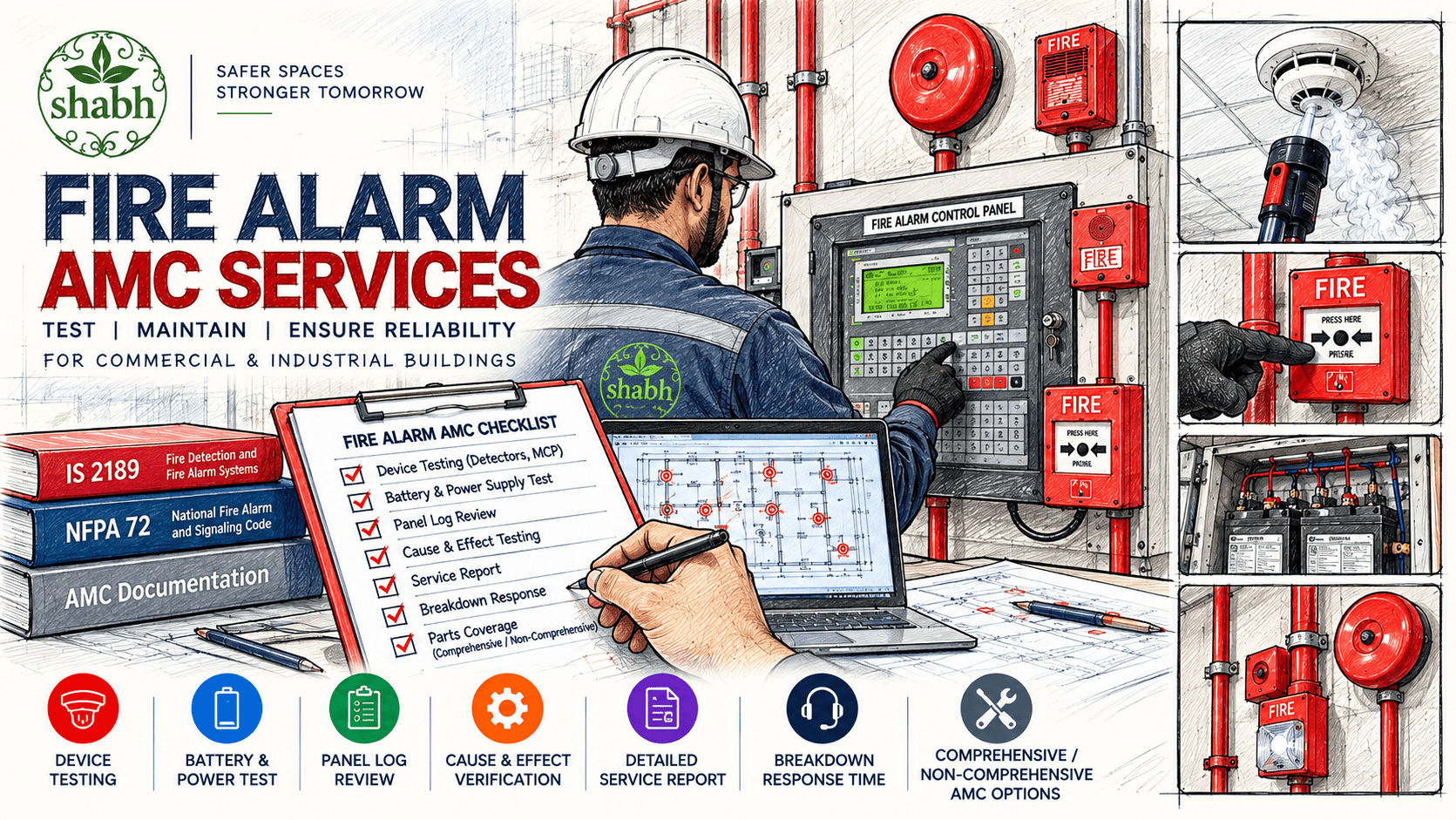
1. Functional testing of devices, not just a panel check. Detectors should be tested with actual smoke or heat stimulus, and manual call points should be physically operated. A contract should state how many devices are tested per visit and confirm that every device is covered across the contract year.
2. Battery and power supply testing under load. A battery can show healthy voltage on a meter and still fail when the panel switches to standby power. The standby test should check how the battery performs under actual load, and the contract should say so.
3. Panel log and fault history review. The event log shows repeated faults, disabled zones, and silenced alarms. A technician who never reads it is missing the clearest record of what’s going wrong in the building.
4. Cause-and-effect verification. When a detector activates, the panel is supposed to trigger hooters, shut down air handling units, release magnetic door holders, recall lifts, and signal the BMS. These outputs fail quietly more often than the detectors do, and a visit that only tests detectors misses them entirely.
5. A written service report after every visit. It should be device-level and zone-level, listing what was tested, what failed, what was repaired, and what remains open. This report is also what a fire department inspector or an insurer will want to see.
6. A stated response time for breakdowns. “Support available” means nothing. The contract should say how many hours until an engineer reaches site after a fault call, and whether that applies at night and on holidays.
7. A clear statement of what’s covered if something needs replacing. This is where most disputes start, so it deserves its own section.
Comprehensive vs. Non-Comprehensive: The Clause That Changes the Real Price
In a non-comprehensive AMC, you pay for labour and visits, and any spare part that needs replacing is billed separately. In a comprehensive AMC, parts and repairs are included, usually with exclusions for damage caused by misuse, water ingress, or vandalism.
Neither is automatically better. A non-comprehensive contract on a new system with low failure risk can be perfectly reasonable. But a cheap non-comprehensive quote on an older system gets expensive quickly, because every replaced detector, battery, or module arrives as a separate invoice. When comparing two quotes, ask each vendor to state what’s included in parts, and compare the total expected cost, not just the headline number.
Red Flags in an AMC Quotation
- No stated visit frequency, or visits described only as “periodic”
- No mention of cause-and-effect testing
- No written report after each visit
- No response time for breakdown calls
- A price noticeably below every other quote, with a scope description that’s noticeably shorter
- No mention of who is responsible for the contract if the original engineer leaves the vendor
Five Questions to Ask Before You Sign
- How many devices are tested at each visit, and how do you ensure every device is covered within the year?
- Do you test the outputs the panel controls, such as hooters, AHU shutdown, and door release, or only the detectors?
- What does the service report contain, and can I see a sample?
- What’s the guaranteed response time for a fault call, including nights and holidays?
- Which parts are covered, and which are billed extra?
A vendor with a real maintenance process will answer these easily. A vendor selling visits will hesitate.
Why This Matters More Than the Price
A fire alarm AMC is one of the few contracts where the failure is invisible until the worst possible moment. A system that was “serviced” four times a year but never functionally tested on its outputs is a system nobody actually knows works. The extra cost of a properly scoped contract is small compared to discovering, during an actual fire or a fire department inspection, that the system was never verified.
FAQ
Q: How often should a fire alarm system be serviced under an AMC?
Q: What’s the difference between an AMC and a one-time service visit?
An AMC is a planned, recurring programme with a defined scope, response time, and reporting. A one-time visit fixes or checks what’s in front of the technician that day, with no ongoing accountability.
Q: Is a comprehensive AMC always better?
No. It depends on the age and condition of the system. Comprehensive cover usually pays off on older systems where parts fail more often, while a non-comprehensive contract can be cheaper over the year on a newer system.
Q: Can I switch AMC vendors mid-contract?
Usually yes, subject to the notice and termination terms in your current contract. Before switching, ask the new vendor to do a baseline audit of the system so any existing faults are documented from day one.
Q: What should I do if my current AMC vendor only provides visit signatures and no report?
Request device-level service reports in writing. If the vendor can’t provide them, that’s a strong sign the visits aren’t covering the full scope, and it’s worth getting a second opinion from another vendor.
Q: Does an AMC help with fire NOC renewal and inspections?
Yes. Consistent service reports and test records are the documentation inspectors and insurers typically ask for, and an AMC that produces them makes renewals and audits much easier.
Shabh Creations Pvt. Ltd. provides fire and life safety consultancy, design, installation, and AMC services for commercial and industrial facilities across India. This article is general guidance and does not constitute a site-specific assessment. AMC scope, testing frequency, and applicable standards should be verified against your facility’s actual systems and local requirements.