
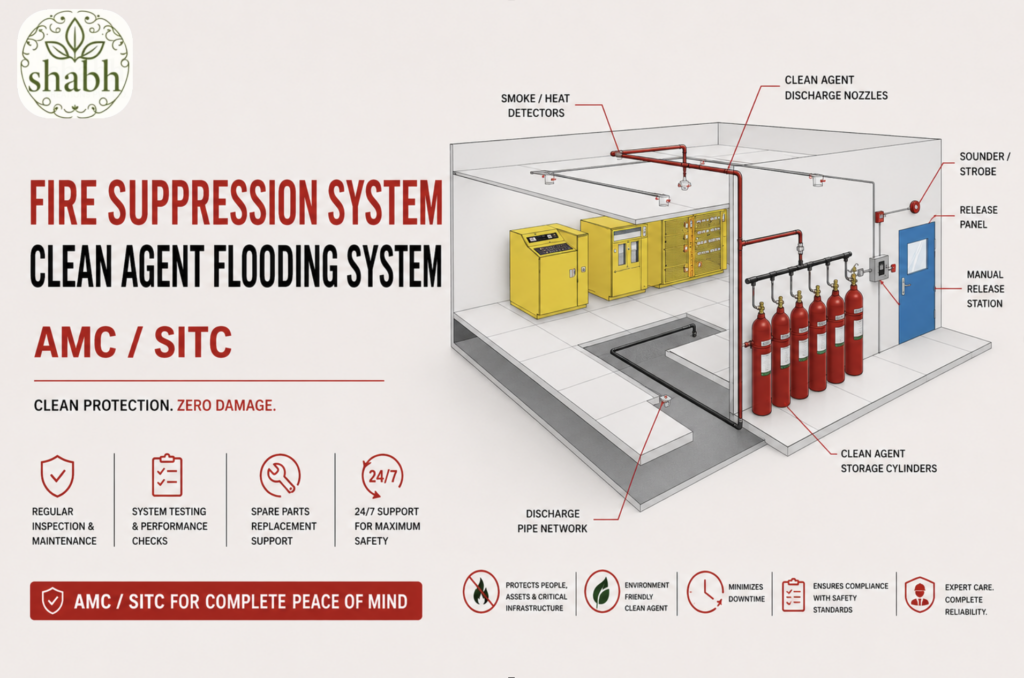
Clean Agent Flooding System AMC & SITC: Complete Guide to Waterless Fire Suppression
Shabh Creations provides expert Supply, Installation, Testing, and Commissioning (SITC) alongside comprehensive Annual Maintenance Contracts (AMC) for specialized clean agent flooding systems, gas suppression systems, and total flooding networks across commercial and industrial facilities.
Protecting critical infrastructure requires advanced fire suppression technology that extinguishes hazards instantly without leaving behind water damage, residues, or conductive agents that destroy sensitive electronics.
Core Technologies and System Variations
Different facilities require specific gas suppressants engineered for localized or total room flooding. We service, supply, and maintain the following infrastructure types:
Clean Agent Based Fire Suppression Systems:
Utilizes advanced chemical and inert gas suppressants (such as FK-5-1-12, HFC-227ea / FM-200, and inert gas blends like Novec 1230) designed to vaporize completely upon discharge, leaving server rooms, data centers, and archives instantly clean and operational.
CO2 Flooding System (Carbon Dioxide Suppression):
A high-pressure or low-pressure total flooding or local application system widely deployed for unmanned spaces, generator rooms, paint booths, and industrial machinery pits.
Complete Total Flooding Systems:
Engineered pipe network configurations designed to discharge extinguishing concentrations uniformly throughout a sealed room within 10 seconds, suppressing Class A, B, and C fires at the molecular level before combustion spreads.
Critical Applications & Protected Environments
Data Centers & Server Rooms:
Safeguards mission-critical server racks, mainframe units, and networking switches against electrical fires without thermal shock or liquid corrosion.
Control Rooms & Telecommunication Hubs:
Secures SCADA control centers, power distribution rooms, and telecom switching stations to maintain 24/7 uptime.
Medical & Diagnostic Facilities:
Protects high-value medical equipment, MRI suites, and hospital path-labs where water-based sprinklers cause catastrophic structural and electrical destruction.
Archives, Museums & Vaults:
- Preserves irreplaceable historical artifacts, legal documents, and financial records from secondary water damage during a fire event.
SITC & AMC Service Scope
Hydraulic Flow Calculations:
Precision engineering of pipe diameters, nozzle orifice sizes, and manifold pressure drops to guarantee complete agent discharge within standardized time frames. (Clean Agent Flooding System AMC & SITC)
Integrity Testing (Door Fan Test):
Verifying room enclosure sealing to ensure the discharged gas concentration holds for the required retention period.
Detection & Control Panel Integration:
Interfacing suppression release panels with smoke detectors, VESDA (Very Early Smoke Detection Apparatus), abort switches, and HVAC shut-off systems. (Clean Agent Flooding System AMC & SITC)
Periodic Maintenance & Refilling:
Routine statutory inspection of cylinder pressure gauges, weighing agents, testing actuator solenoids, and recertifying high-pressure cylinders. Contact us
Regional Coverage & Industrial Deployment Across NCR
Shabh Creations delivers certified SITC and Annual Maintenance Contracts (AMC) for clean agent flooding and gas suppression networks across major industrial, commercial, and tech corridors:
- National Capital Region (NCR) & Delhi: Engineering statutory compliance and rapid-response servicing for corporate commercial spaces, data centers, and critical vaults.
- Noida & Greater Noida: Specialized installation and pressure testing across Sectors 18, 62, 63, 135, 142, and 148, the Noida Special Economic Zone (NSEZ), Block A, Phase-2, Surajpur Industrial Area, Block E, UPSIDC Site C, Ecotech-II, Udyog Vihar & Kasna, and projects surrounding the Jewar logistics zone.
- Gurugram & Manesar, Haryana: High-performance fire protection setups and cylinder refilling services spanning Udyog Vihar and DLF Cyber City tech parks.
- Faridabad, Haryana: Dedicated industrial maintenance contracts protecting heavy engineering, manufacturing plants, and electrical switchgear rooms.
Advanced Technical FAQ & Engineering Parameters Related to Clean Agent Flooding System
What are the specific discharge concentration standards for a clean agent flooding system under NFPA 2001?
Under NFPA 2001 standards, a clean agent based fire suppression system must achieve its design concentration (typically 4.2% to 5.8% for FK-5-1-12 / Novec 1230, and 6.2% to 7.0% for HFC-227ea / FM-200) within a maximum discharge time of 10 seconds through engineered pipe networks to minimize thermal decomposition and flame front propagation. (Clean Agent Flooding System AMC & SITC)
How do hydraulic flow calculation software packages determine pipe sizing for gas suppression systems?
Hydraulic calculations use specialized multiphase flow modeling algorithms (such as VdS, Fike, or Kidde software) to account for manifold pressure drop, pipe friction losses, tee splits, and two-phase gas-liquid transition dynamics. This ensures balanced mass flow rates through every nozzle orifice and prevents excessive pressure drops that cause agent condensation or valve freeze-ups. (Clean Agent Flooding System AMC & SITC)
What is the engineering purpose of an Enclosure Integrity Test (Door Fan Test)?
Mandated by NFPA 2001 and ISO 14520, the Door Fan Test measures room airtightness using a specialized fan unit mounted in a doorway. It determines the equivalent leakage area (ELA) to verify that the enclosure can maintain the required agent holding concentration (typically a minimum of 80% of design concentration) for a specified retention time—usually 10 minutes—preventing fire re-ignition in deep-seated hazards before emergency response teams arrive.(Clean Agent Flooding System AMC & SITC)
What are the operational differences between low-pressure and high-pressure CO2 flooding systems?
A high-pressure CO2 total flooding system stores liquid carbon dioxide in steel cylinders pressurized at 850 PSI (58 bar) at 21°C, deployed primarily for smaller localized risks, generator enclosures, and paint lines. A low-pressure CO2 system utilizes a refrigerated storage tank maintained at roughly 300 PSI (20 bar) at -18°C, engineered for massive industrial facilities requiring large aggregate agent reserves and multi-zone distribution manifolds.
How does a complete total flooding system integrate with VESDA and HVAC interlocks?
Total flooding networks require a dual-knock (coincident) detection logic—usually combining photoelectric smoke detectors with very early smoke detection apparatus (VESDA)—to trigger an abort switch time-delay sequence. Upon activation, suppression control panels execute hard-wired safety interlocks: shutting down AHUs (Air Handling Units), closing motorized fire dampers to preserve gas concentration, tripping emergency power off (EPO) breakers, and activating audiovisual pre-discharge strobes and sirens.(Clean Agent Flooding System AMC & SITC).