
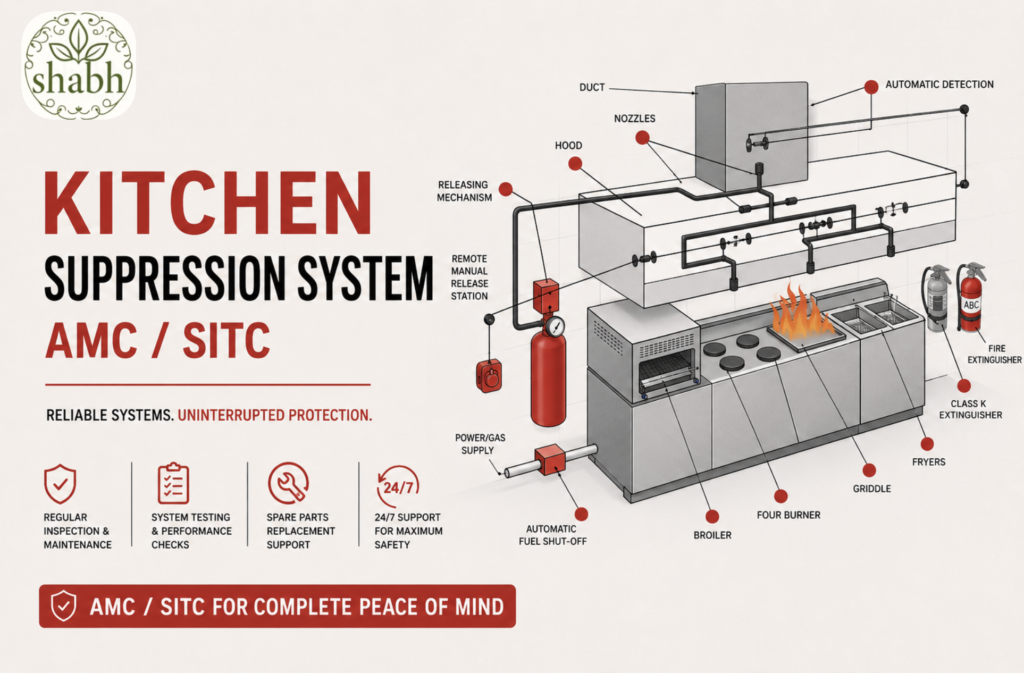
Complete Kitchen Fire Suppression System AMC & SITC Solutions
UL 300 and NFPA 96-compliant wet chemical kitchen fire suppression systems, installation, and comprehensive annual maintenance contracts (AMC) for commercial kitchens, restaurants, hotels, and cloud kitchens across Delhi NCR.Complete Kitchen Fire Suppression System AMC & SITC Solutions
Complete SITC & Maintenance Solutions
System Design & Installation (SITC):
Custom engineering and professional setup of automatic wet chemical suppression systems tailored to kitchen hood layouts, ducts, and cooking appliances.Complete Kitchen Fire Suppression System AMC & SITC Solutions.
Periodic AMC & Inspection: Kitchen Fire Suppression System
Rigorous routine safety checks, nozzle alignment tests, mechanical link inspections, and preventive maintenance cycles.
Cylinder Refills & Servicing: Kitchen Fire Suppression System
Safe discharge management, wet chemical agent refills, and pressure testing for all primary suppression cylinders.
24/7 Support & Emergency Service: Contact Us
Rapid-response technical assistance across all major industrial clusters and commercial food hubs.
Service Zones Across Delhi NCR for Kitchen Fire Suppression System
Noida & Greater Noida:
Noida Special Economic Zone (NSEZ), Sector 62, Sector 18, Sector 63, Sector 135, Sector 142, Sector 148, Surajpur Industrial Area (Block E, UPSIDC Site C), Ecotech-II Udyog Vihar, Kasna, and Jewar.
Gurugram & Manesar:
DLF Cyber City (Phase 2), Udyog Vihar Sector 19, and Manesar Industrial Hub.
Delhi & NCR Corridors:
Faridabad and Ghaziabad commercial zones.
Frequently Asked Questions (FAQ)
How can restaurants and cloud kitchens in Noida and Gurugram verify if their fire suppression setup is fully compliant with local fire norms?
Compliance requires a dual check: adherence to international codes like UL 300 / NFPA 96 for system design, and obtaining local state fire safety clearance certificates. Our engineering teams conduct exhaustive safety audits across hubs like Sector 62 Noida and DLF Cyber City to ensure your documentation clears municipal inspections without delay.
What emergency steps should kitchen staff take immediately if a wet chemical fire suppression system discharges?
Upon automatic or manual discharge, staff must immediately:
Refrain from washing away the residue until the agent has completely cooled the media, then contact our 24/7 emergency response line for system resets and chemical recharges.
Shut down all electrical power sources and gas supply lines to cooking appliances.
Evacuate the immediate cooking zone and allow the wet chemical agent to blanket and saponify hot grease oils.
Why are traditional water-based or dry powder extinguishers insufficient for commercial kitchen deep-fryer fires?
Water causes hot cooking oil to splatter aggressively, spreading flames instantly, while standard dry chemical powders offer only temporary knockdown with high re-ignition risks. Specially engineered wet chemical systems convert cooking oils into a soap-like foam via saponification, sealing the surface, cutting off oxygen, and cooling the appliance simultaneously.
What is the turnaround time for scheduled AMC servicing and chemical refilling across Delhi NCR?
Routine preventive maintenance checks are completed within 24 to 48 hours of scheduling. For post-discharge emergency refills in high-intensity commercial food hubs like NSEZ, Udyog Vihar, and Cyber City, our rapid-deployment technical teams arrive on-site immediately.
Are wet chemical suppression systems compatible with all commercial cooking appliances?
Yes, these systems protect all major heavy-duty cooking equipment—including deep-fat fryers, griddles, upright charbroilers, standard rangetops, and wok stations—by instantly extinguishing flare-ups at the source.