
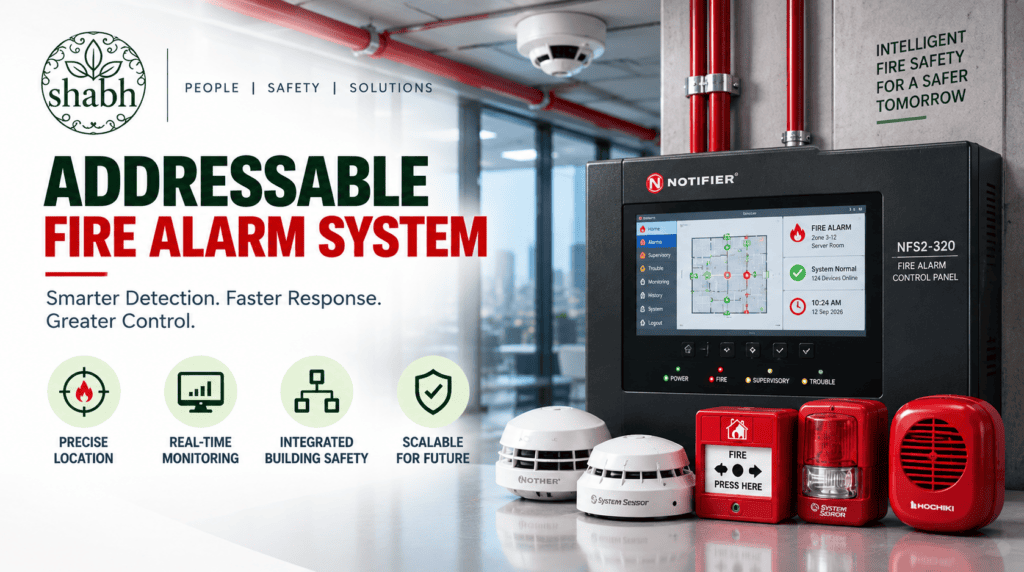
Expert Fire Alarm System Design & Integration: Mastering Addressable Solutions
Safeguarding complex commercial, industrial, and high-occupancy facilities requires absolute precision. In critical environments, knowing simply that a fire has occurred is not enough; you must know its exact location instantly. An addressable fire alarm system delivers this pinpoint accuracy, dramatically reducing emergency response times and enabling sophisticated building integrations.
However, advanced hardware is only as effective as the engineering behind it. Achieving regulatory compliance and fail-safe reliability requires the expertise of a specialized system designer and a comprehensive fire alarm system provider. This guide details how addressable networks operate, the critical role of the control panel, and why specialized design is non-negotiable.
What is an Addressable Fire Alarm System?
Unlike conventional systems that group devices into broad physical zones, an addressable alarm system assigns a unique digital address (or ID) to every single connected device—whether it is a smoke detector, heat sensor, manual pull station, or interface module.
These devices are wired in a loop that connects back to the main control panel. If a specific detector senses smoke in “Room 402,” the panel immediately displays that exact location. This pinpoint identification is crucial for large campuses, high-rises, hospitals, and heavy industrial plants where rapid, targeted evacuation and response are necessary.
The Intelligence Hub: The Addressable Fire Alarm
The central brain of this network is the addressable fire alarm panel. Because the panel communicates digitally with every device on the loop, it can perform highly advanced functions that go far beyond simply sounding an alarm.
Key capabilities of an addressable alarm panel include:
- Exact Location Reporting: Instantly identifies the specific device in alarm, supervisory, or trouble state.
- Constant Device Polling: The panel continuously communicates with each detector to verify its operational status, immediately flagging removed devices or internal faults.
- Drift Compensation: Advanced panels can monitor dust accumulation inside a detector and automatically adjust its sensitivity threshold, significantly reducing false alarms.
- Complex Cause-and-Effect Logic: The panel can be programmed to execute specific sequences during an emergency, such as phasing evacuations by floor, shutting down specific HVAC dampers, or grounding elevators in a precise order.
The Critical Role of a Fire Alarm System Designer
Addressable technology is highly sophisticated, making the role of a fire alarm system designer absolutely critical. Fire alarm design is not a standard electrical task; it requires deep knowledge of fire dynamics, building codes (such as NFPA 72 or BS 5839), and manufacturer-specific system architecture.
A specialist designer is responsible for:
- Loop Calculations: Ensuring that the voltage drop and battery calculations support the maximum number of devices on the addressable loop.
- Detector Selection & Spacing: Choosing the correct sensor type (e.g., optical smoke, rate-of-rise heat, multi-sensor) based on the environmental risks of specific rooms.
- Integration Matrix: Mapping out the cause-and-effect programming so the addressable system correctly triggers third-party building management systems (BMS), sprinkler monitors, and access control doors.
- Compliance & Permitting: Generating the detailed CAD drawings, riser diagrams, and battery calculations required by the Authority Having Jurisdiction (AHJ) for project approval.
Why Partner with an End-to-End Fire Alarm System Provider?
While a standalone designer can draft the blueprints, partnering with a full-service fire alarm system provider ensures that the system is supplied, installed, programmed, and maintained exactly as engineered.
A comprehensive provider manages the entire lifecycle of the system. They ensure that the specific panel chosen is programmed correctly, conduct the rigorous commissioning and acoustic testing required for handover, and establish an Annual Maintenance Contract (AMC) to keep the system compliant and operational for years to come.
Frequently Asked Questions
1. When should a fire alarm system designer recommend an addressable system over a conventional one?
A fire alarm system designer will typically specify an addressable alarm system for large, complex, or high-occupancy buildings where pinpointing the exact location of a fire is critical for life safety. They are also required when the building strategy demands complex cause-and-effect programming, such as integrated HVAC shutdowns or phased evacuations.
2. Can an existing conventional system be upgraded to an addressable fire alarm system?
Yes, but it requires a detailed site audit by a fire alarm system provider. While an addressable fire alarm panel and new addressable devices must be installed, it is sometimes possible to reuse existing conventional cabling if it meets the specific shielding and resistance requirements of the new addressable manufacturer.
3. How does an addressable fire alarm panel integrate with building sprinkler systems?
Through the use of addressable monitor modules wired onto the system loop. These modules connect to the sprinkler system’s waterflow switches and valve tamper switches. When water flows, the module sends a digital signal with its unique ID to the addressable fire alarm panel, alerting building management to the exact location of the activated sprinkler.
4. What is cause-and-effect programming in fire alarm design?
Cause-and-effect (or input/output) programming is the logic matrix created by a fire alarm system designer. It dictates exactly what the addressable fire alarm panel should do when a specific event occurs. For example: If Smoke Detector 12 in the IT Room activates (Cause), Then release the IT room access doors, trigger the FM-200 suppression system, and sound the alarms only on that specific floor (Effect).
5. How does an addressable system help reduce maintenance costs and false alarms?
Because the addressable fire alarm panel constantly polls individual devices, it can report exact maintenance needs—such as alerting a fire alarm system provider that a specific smoke detector in a specific room is 80% contaminated with dust and requires cleaning before it triggers a false alarm.
Looking for an Expert Fire Alarm System Designer & Provider?
Shabh Creations provides specialized fire alarm system design, supply, installation, programming, commissioning, testing, and AMC support for complex commercial, industrial, and critical facilities.
Our addressable fire safety services include:
- Dedicated fire alarm system designer services for new builds and retrofits
- Addressable fire alarm panel supply, installation, and programming
- Expertise in major brands including Notifier, Edwards/EST, Hochiki, and Morley
- Advanced cause-and-effect programming and BMS/HVAC integrations
- Sprinkler waterflow and suppression system monitoring
- Complete testing, commissioning, and system audits
- Comprehensive Annual Maintenance Contracts (AMC)
For a highly engineered, code-compliant addressable solution, the right starting point is a detailed facility assessment to determine your exact life-safety requirements.