
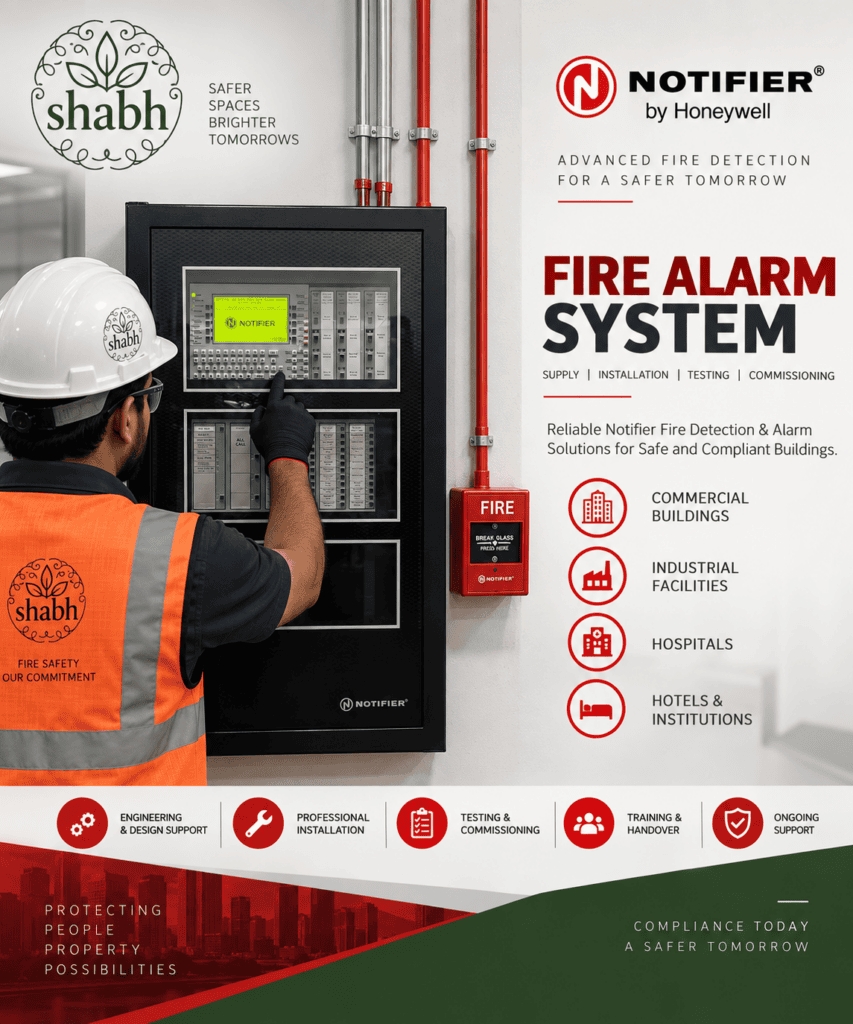
Complete Notifier Fire Alarm Installation & SITC Scope of Work
- 1. Supply & Engineering Design:
- OEM-sourced Honeywell Notifier panels, intelligent FlashScan smoke and thermal sensors, manual call points (MCPs), loop isolator modules, and addressable sounder strobes.
- Loop calculation sheets, standby battery sizing calculations, and CAD layout mapping tailored to facility occupancy risks.
- 2. Field Wiring & Physical Installation:
- Laying 2-core 1.5 sq mm / 2.5 sq mm shielded FRLS / mineral-insulated copper cabling in Class A (redundant ring) or Class B configurations.
- Precise detector spacing and placement in compliance with ceiling heights, HVAC air distribution paths, and industrial beam obstacles.
- Our engineering team manages the entire installation end-to-end, ensuring Class A loop integrity and fault-free containment.
- 3. Notifier Fire Alarm Panel Programming:
- Logic programming via Honeywell VeriFire® Tools: mapping complex Cause-and-Effect matrices, zone assignments, and intelligent drift compensation.
- Interlocking life-safety integration: automated HVAC fire damper trip, AHU shutdown, elevator grounding recall, access control door unlock on alarm, and Voice Alarm / PA system triggers.
- 4. Testing, Commissioning & Handover:
- Comprehensive pre-power checks: loop insulation resistance (Megger test), continuity verification, and ground-fault clearance.
- Live aerosol smoke/heat simulation on 100% of field devices, decibel level measurement across sounder circuits, and full fire-trip simulation before local Fire Authority inspection.
Supported Notifier Panels & Network Architecture
- Intelligent Addressable Panels: We select and engineer hardware based on facility scale to ensure every notifier fire alarm installation meets strict loop load and survivability standards.
- Small-to-Mid Facilities: Notifier NFS-320 (Single loop, up to 318 addressable devices, ideal for standalone commercial setups and retail).
- Mid-to-Large Complexes: Notifier NFS2-640 (Up to 2 loops, supporting 636 intelligent devices with modular networking).
- Enterprise & Industrial Plants: Notifier NFS2-3030 (Large-scale intelligent panel supporting up to 10 loops, 3,180 devices, and master graphic annunciators).
- Multi-Building Campuses: NOTI•FIRE•NET™ multi-panel token ring networking over twisted-pair wire or multimode/single-mode fiber optic cabling.
- Network & Interface Modules: NCM-W/F network communication modules, loop expansion boards, and ACM series annunciators.
- Field Devices: FlashScan smoke detectors, thermal sensors, manual call points (MCPs), monitor/control modules, and addressable sounder strobes.
Legacy Modernization: Conventional to Notifier Addressable Migration
Upgrade outdated hardwired conventional fire alarm setups to advanced, intelligent Notifier addressable systems. Our migration process leverages existing loop infrastructure where feasible while deploying standard-compliant installation practices, precise device-level identification, and zero false-alarm optimization, and intelligent cause-and-effect programming. For additional internal safety resources, review our fire safety services portfolio. Contact us
- Infrastructure Optimization: We audit your existing cable pathways to determine if conduit routing can be preserved, cutting deployment costs.
- Zero Downtime Cutover: Phased floor-by-floor migration to ensure active fire detection coverage remains operational during panel and device replacement.
- Pinpoint Accuracy: Replace vague 30-detector zones with discrete device addresses, allowing your security team to identify the exact room, detector, and smoke level within seconds.
Key Industrial & Commercial Hubs We Service
Our technical engineering teams operate directly out of Noida with rapid project mobilization across:
- Noida: Sector 62, 63, 65 (Industrial & IT Hubs), Sector 18, Expressway SEZs (Sector 125 to 144).
- Greater Noida & YEIDA: Surajpur Industrial Area, Ecotech Zones, Kasna, Pari Chowk, and Knowledge Parks.
- Delhi NCR: Gurugram (Udyog Vihar, Manesar, Cyber City), Faridabad, and Ghaziabad industrial belts.
Our 4-Stage Commissioning & Handover Process
- Pre-Commissioning Audit: Wiring megger check, polarity testing, and loop resistance verification prior to full system power-up.
- Device Addressing & Mapping: Individual soft/rotary addressing and field loop verification.
- Cause-and-Effect Live Simulation: Smoke injection testing, relay trip confirmation (HVAC/elevators), and sounder dispersion checks.
- Authority Handover & Documentation: As-built drawings, cause-and-effect matrices, device lists, and sign-off reports ready for local Fire NOC inspection.
Regulatory Compliance & Life-Safety Standards (NFPA, UL & BIS)
Every turnkey installation executed by Shabh Creations complies with statutory Indian building bylaws and international fire engineering standards:
- National Building Code of India (NBC 2016 – Part 4):Full adherence to occupancy-specific life-safety mandates, evacuation zoning, sounder decibel dispersion (minimum 65 dBA / 5 dBA above ambient), and automated integration with AHUs and stairwell pressurization fans.
- Bureau of Indian Standards (IS 2189:2008 / BIS):Rigorous application of the Bureau of Indian Standards Code of Practice for the Selection, Installation, and Maintenance of Automatic Fire Detection and Alarm Systems, covering Class A loop resistance limits and 24-hour backup battery autonomy.
- Underwriters Laboratories (UL Listed):Deployment of OEM hardware tested under UL 864 (Control Units and Accessories for Fire Alarm Systems), ensuring system stability, fault monitoring, and transient surge protection.
- National Fire Protection Association (NFPA 72 Standards):System design, detector spacing criteria, and Notification Appliance Circuit (NAC) power calculations benchmarked against global National Fire Alarm and Signaling Codes.
- By adhering to strict NBC and NFPA guidelines on every installation, our engineering team works to minimize audit friction during local Fire Department NOC inspections.
Looking for Ongoing Maintenance instead of New Installation?
If your facility already has an operational system and requires quarterly testing, compliance reports, or emergency fault repairs, explore our dedicated Notifier Fire Alarm AMC Services across Noida & NCR.
Value-Added Engineering Services
Free On-Site Fire Safety Audits:
Comprehensive facility assessments to check zone health, wiring integrity, and panel performance without upfront costs.
Panel Programming & Troubleshooting:
Expert on-site commissioning, loop mapping, and rapid-response fault diagnosis for new and existing notifier fire alarm installation projects
System Integration:
Seamless integration of Notifier panels with Building Management Systems (BMS), HVAC shutdown loops, access control, and automated suppression systems.
Real-Life Engineering & Statutory FAQs (Frequently Asked Questions)
What documentation is provided after commissioning for local Fire NOC clearance?
Upon commissioning sign-off, we hand over a statutory compliance binder containing as-built schematic drawings, device loop schedules, battery backup autonomy calculations, certified 100% test logs, Cause-and-Effect logic matrices, and the manufacturer warranty certificate required by regional fire authorities.
Why is loop calculation critical before pulling fire alarm cable?
Every addressable detector, module, and loop-powered sounder introduces an electrical load. Without running formal loop resistance, capacitance, and voltage-drop calculations, panels can suffer from intermittent communication drops, phantom ground faults, or device drop-outs during full alarm load.
Can Notifier addressable systems integrate with third-party BMS via BACnet or Modbus?
Yes. We configure Notifier gateway modules (such as the BACnet Gateway or Modbus Gateway) to broadcast real-time panel status, device-level trouble signals, and active alarm telemetry directly to your central Building Management System (BMS) workstation.
What is the typical installation timeline for a 2-loop Notifier panel in an IT facility?
Physical containment, cabling, and device mounting for a complete notifier fire alarm installation typically take 2–3 weeks depending on site access. Testing, logic programming, Cause-and-Effect integration, and commissioning require an additional 3–5 days, concluding with a live simulated drill.
How does Class A loop wiring differ from Class B in critical installations?
Class A wiring leaves the panel, loops through all field devices, and returns to the panel’s terminal block. We recommend Class A configurations for every mission-critical installation because if a cable cut occurs, the panel communicates from both ends, keeping 100% of devices operational. Class B wiring dead-ends at the last device; a single cable break will disable everything downstream of the fault.
Does Shabh Creations perform third-party programming for existing uncommissioned Notifier panels?
Yes. If your MEP contractor has pulled cables and installed devices but lacks expert engineering support to configure loop software, resolve ground faults, and compile the Cause-and-Effect logic, our engineers handle on-site testing and commissioning.